
Every month we send an email newsletter to our supporters sharing recent updates from our work. We publish selected portions of the newsletter on our blog to make this news more accessible to people who visit our website. For key updates from the latest installment, please see below!
If you’d like to receive the complete newsletter in your inbox each month, you can subscribe here.
GiveWell in the Media
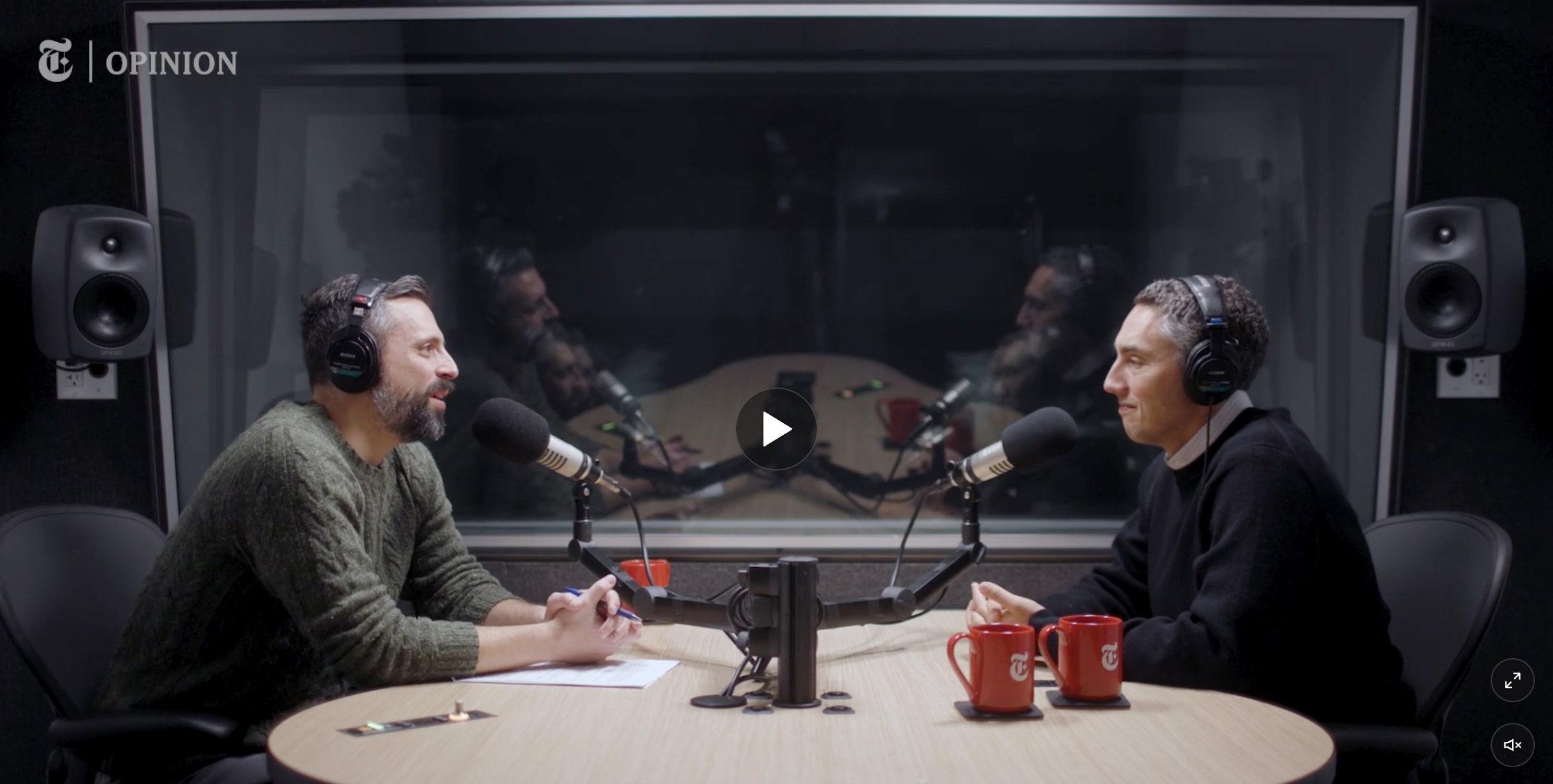
We’re excited to share two recent media features that offer an in-depth look at GiveWell’s work. GiveWell CEO and co-founder Elie Hassenfeld joined The Ezra Klein Show to discuss our distinct approach to helping donors do the most good they can, and NPR’s Planet Money did a deep dive with our team as we researched a potential grant responding to foreign aid cuts.
The Ezra Klein Show: “The Simplest Way to Save Lives With Your Money”
Elie joined Ezra Klein, a longtime GiveWell supporter, for a conversation exploring the rigor and methodology behind the grants we make with our donors’ funds. They discuss how we weigh different program outcomes (such as lives saved versus income increased), our approach to transparency, and the value of supporting GiveWell’s evidence-based opportunities. The conversation also covers how this year’s foreign aid cuts have intensified grantmaking and includes stories from Elie’s recent visit to Malawi. The full episode is available on the New York Times website and wherever you get your podcasts.
NPR’s Planet Money: “Saving Lives with Fewer Dollars”
Planet Money followed along with our research team over several weeks as we evaluated whether to fund the Alliance for International Medical Action (ALIMA) to maintain primary healthcare and malnutrition treatment in North Cameroon following unexpected aid cuts earlier this year. The episode follows researchers Rosie Bettle, Alice Redfern, and Teryn Mattox as they work through the grant investigation and ultimately decide to approve a $1.9 million grant, filling the funding gap left by USAID for that program for one year. Listen to the full episode here.

GiveWell Conversations: “Behind the Planet Money ALIMA Grant Story”
We published an episode following up on Planet Money—diving deeper into the ALIMA grant investigation with Program Officers Rosie Bettle and Alice Redfern and discussing the grant’s timeline, our modeling approach, and what ultimately led us to make the grant.
Elie, Rosie, and Alice discuss:
- The grant investigation timeline: Due to the urgent need created by unexpected aid cuts, GiveWell completed the investigation in about six weeks from start to finish, despite this program’s wide scope.
- How we adapted our modeling: As part of evaluating this grant on a shortened timeline, GiveWell used a series of simple models—rather than one comprehensive model—to estimate cost-effectiveness.
- An update on grant progress: With GiveWell’s funding, ALIMA’s program is up and running again and is on track to treat the number of children GiveWell expected.
Growing Needs, Shrinking Aid Webinar and Follow-up
On December 4, GiveWell hosted a live webinar titled “Growing Needs, Shrinking Aid: Cost-Effective Action in a Year of Funding Cuts.” Elie moderated a panel of GiveWell researchers to discuss the effects of this year’s foreign aid funding cuts, how GiveWell is responding, and what we’re learning along the way—including our predictions and uncertainties about the future. The panelists answered questions selected live by attendees and shared their latest insights. Watch the video or listen to the audio on our podcast.

We published a follow-up blog post addressing some questions we didn’t have time to cover during the webinar, along with additional audience-submitted questions, focusing on four themes: the challenges of an uncertain future, taking action in the face of uncertainty, the role of cost-effectiveness, and future GiveWell grantmaking.
Coefficient Giving Funding Announcement
We are excited to share that Coefficient Giving, formerly Open Philanthropy, has decided to renew and increase their funding for GiveWell, committing to set aside $175 million in 2026 for opportunities we recommend.
This is great news for the people our grants help, and it comes at a critical moment. Following 2025’s aid cuts, we think needs are greater than they were a year ago, and we expect they will continue to grow in the coming years as the impacts of current and future cuts mount. We’re grateful to see donors—including Coefficient Giving—stepping up and signaling that they trust us to help in the years ahead.
End-of-Year Giving to Help People in Need
We just published our annual staff giving blog post, where GiveWell staff members share the thinking behind their personal donations for the year. Staff approaches vary widely—some give entirely to GiveWell’s funds, while others focus on causes like animal welfare, climate change, or local community needs. We hope this glimpse into our team’s personal giving is helpful as you think through your own giving decisions.
This has been a tumultuous year for global health. Early in 2025, the US government froze billions of dollars in foreign aid, affecting millions of people around the world. As part of our grantmaking this year, we expect to commit over $40 million to grants that directly address urgent needs created by the cuts—funding time-sensitive malaria campaigns, procuring essential health supplies, and supporting governments as they navigate the uncertainty. With fewer resources going to global health and development programs, we believe giving now has greater potential impact than before the cuts. You can help us respond to an uncertain future for global health by supporting the giving fund that best matches your giving preferences.
If you’re planning to give this holiday season, a few reminders:
- We recommend using our online donation form to donate via ACH, credit card, PayPal, Google Pay, or Apple Pay whenever possible.
- If you’re concerned with 2025 tax deductibility, check the charitable tax donation deadlines, and be sure to consider holidays and weekends to ensure adequate processing time.
- If we can help with your end-of-year giving in any way, please reach out to info@givewell.org.
Other helpful resources for your giving season:
- Information About Donating
- Charitable Tax Donation Deadlines for 2025 (US donors)
- Global Tax Deductibility Guidelines
- Making a Donation of Cryptocurrency to GiveWell
We’re deeply grateful for your support and wish you a wonderful holiday season!
Grant Spotlight
Our grantmaking supports programs and research that aim to save and improve lives the most per dollar. Here’s a look at one recent example:
Where: Democratic Republic of the Congo, Madagascar, Nigeria
What: A three-month qualitative assessment of how US government funding cuts are impacting key parts of the vaccine delivery system
Who: Results for Development (R4D)
Amount: $271,445
How it works: This research addresses a critical lack of on-the-ground information about the real-world consequences of this year’s US government funding cuts on vaccine delivery, including the effects on vaccinators and healthcare workers, outreach sessions, supply chains, and data systems.
Why this grant: The findings will inform GiveWell’s vaccines strategy by providing qualitative updates to help us manage existing grants and prioritize future funding. R4D’s facility-level data collection offers critical insights that would be difficult for GiveWell to access otherwise.
Funded by: Donations to GiveWell’s All Grants Fund
To learn more, check out the grant page.
Partner Roundup
- Read why all four of GiveWell’s Top Charities are promoted in Vox’s Giving Tuesday Guide.
- Celebrate Malaria Consortium’s 2025 impact, including over 100 million courses of SMC medicines distributed and over 22.5 million children reached!
- See how one vaccination clinic staff member ensures his remote clinic stays stocked with life-saving vaccines as part of New Incentives’ program.
Comments or Questions?
We’re always looking for fresh perspectives on our research. If you have comments or questions on our work, we want to hear from you! Reach out to us at info@givewell.org.
Comments
For years, GiveWell hosted a quarterly open forum where readers could ask questions. I looked for it recently and couldn’t find it—so I’ll ask my question here, in public, where numbers can be challenged.
In an earlier forum, GiveWell answered a wonderfully concrete question: What is the marginal cost to save a life?
The answer—about $8,000 in 2024—stuck with me because it was simple, explainable, and falsifiable.
So here is my next question:
With GiveDirectly, what is the marginal cost to double consumption for a lifetime?
Let me start with a deliberately naïve picture—not because it’s correct, but because clarity often begins with numbers that are wrong in obvious ways.
Imagine a $1,000 transfer to a household of one-person living on $1,000 per year. Imagine an expected lifespan of 60 years. Very roughly, doubling lifetime consumption would cost about $60,000, before adjusting for fungibility, spillovers, marginal effects, and all the real-world complexities that GiveWell already studies carefully.
Why ask this?
Because I want to compare saving a life with enriching a life over the same time span: one lifetime, at the margin. I know the moral weights framework well—but translating everything into moral units can obscure the intuition rather than clarify it.
A single number—the cost to double consumption for a lifetime—would make the comparison stark, transparent, and human-scale.
So my question, simply put, is:
Does GiveWell have a recent estimate, or even a rough range, for the marginal cost to double lifetime consumption via GiveDirectly?
Sometimes, one clear number can change how I see the world.
Hi Ethan,
Thanks for your question! We’re always happy to hear questions via the comments section of any blog post or by email.
Our very rough estimate for the marginal cost to double consumption for a lifetime based on our current evaluation of GiveDirectly is approximately $19,000, based on the following:
– Our best guess is that the average recipient of an unconditional cash transfer in Kenya lives off $275 annually (nominal).
– GiveDirectly’s overhead is around 15%.
– Based on that, it would cost around $316 ($275 x 1.15) to double consumption for one person for one year.
– Multiplying an expected life span of 60 years by $316 results in a cost of $18,960.
However, this doesn’t account for economic growth (it becomes more expensive to double consumption if people’s consumption is increasing anyway), and it doesn’t include spillover or mortality benefits. A more precise estimate would require thinking more about these factors.
Twenty thousand dollars is a remarkably informative number. It gives me a concrete yardstick. With it, I can place two very different interventions on the same scale: about $8,000 to save a life, and about $20,000 to radically enrich a life. Numbers like these help me think more clearly—and argue less emotionally.
What truly stopped me was this: the average recipient in Kenya lives on $300 per year. Not per month. Per year. That fact alone recalibrates what “impact” really means.
If a researcher has time, then I have two follow-up questions, both about marginal effects rather than slogans:
1. If someone donates $20,000 to GiveDirectly, can they be confident that this money reaches households at the very bottom of the income distribution—people living on the order of $300 per year? In other words, is the targeting precise enough that we are really talking about the poorest of the poor?
2. The $20,000 figure—is this an average cost to double consumption across recipients, or is it the marginal cost to double consumption for someone already at that extreme level of poverty?
Because the difference matters. Averages describe the world as it has been. Margins tell me what I could do next.
Hi Ethan,
Thanks for your follow-up questions! Our estimated annual consumption of ~$275 per year in Kenya is the mean consumption of the bottom quintile from the household budget survey, adjusted slightly upward based on other consumption surveys, so it doesn’t represent the very bottom of the income distribution.
We believe that GiveDirectly is able to target people at this consumption level because poverty is highly spatially correlated, allowing GiveDirectly to target areas where people are extremely poor. In addition, we estimate that GiveDirectly has been able to provide transfers to only a small fraction (around 3.3%) of people living in extreme poverty in Kenya. As a result, we believe that the average and marginal costs do not differ significantly.
Jeremy,
What reassures me is how closely the average and marginal impacts align for GiveDirectly in Kenya. When accounting is this transparent, it builds trust. GiveWell spreadsheets are not just bookkeeping. They are a map of impact. That map continues to guide me toward the Top Charities Fund with strong confidence.
Let us restate the anchor number. Chandler estimated that a marginal 20000 dollar donation to GiveDirectly in Kenya could double one person lifetime income. That is an extraordinary claim. It shows that in the poorest regions of the world, sums that feel moderate in rich countries sit at a powerful leverage point in human welfare.
Then comes the complication. In 2025, a GiveWell researcher suggested that total benefits may be about three times the direct cash value once spillovers and indirect effects are included. (LINK)
This is where my intuition becomes naive and I want to check it. A simple mind divides 20000 by 3 and gets roughly 7000. The naive interpretation would be that a 7000 dollar marginal donation produces the same welfare effect as doubling one lifetime income. But I am unsure whether that arithmetic is too crude for how GiveWell intends the multiplier to be interpreted.
The distinction matters because multipliers describe a system, not a single transaction. They are not automatically redeemable in a linear way. I suspect the correct interpretation is more nuanced, and I would value a clearer translation of the three times estimate into an intuitive marginal figure.