
Anemia, which is commonly caused by iron deficiency, can cause fatigue, cognitive impairment, and complications during pregnancy—and it affects roughly a quarter of the world’s population. Over the last decade, GiveWell has directed nearly $50 million to programs to address this health issue.
Because of the large number of people affected and the low cost to provide people with iron, we are evaluating additional iron fortification and supplementation programs to potentially increase our grantmaking in this area. At the same time, it has been difficult to determine exactly how much providing people with additional iron improves their lives. GiveWell’s growing research capacity is allowing us to study the programs we’ve funded and to support new research, then to use what we learn to continue improving our funding decisions.
In this episode, GiveWell co-founder and CEO Elie Hassenfeld speaks with Researcher Andrew Martin about GiveWell’s work on iron: why the evidence is more complicated than it might seem, what we’ve learned from years of funding iron programs, and what’s ahead.
Elie and Andrew discuss:
- The evidence for iron: Anemia is a significant problem, but it can be hard to determine the exact magnitude of the benefit that comes from addressing it. In addition, current definitions of anemia, which can be caused by iron deficiency, are based on statistical data about typical hemoglobin levels rather than on people’s symptoms. GiveWell is supporting a randomized controlled trial in Bangladesh that aims to address this by measuring how providing additional iron affects perceived fatigue and other health outcomes—helping determine measurable thresholds at which people experience significant symptoms. We think the findings could reshape our understanding of how anemia affects people’s lives and improve our anemia-related grantmaking.
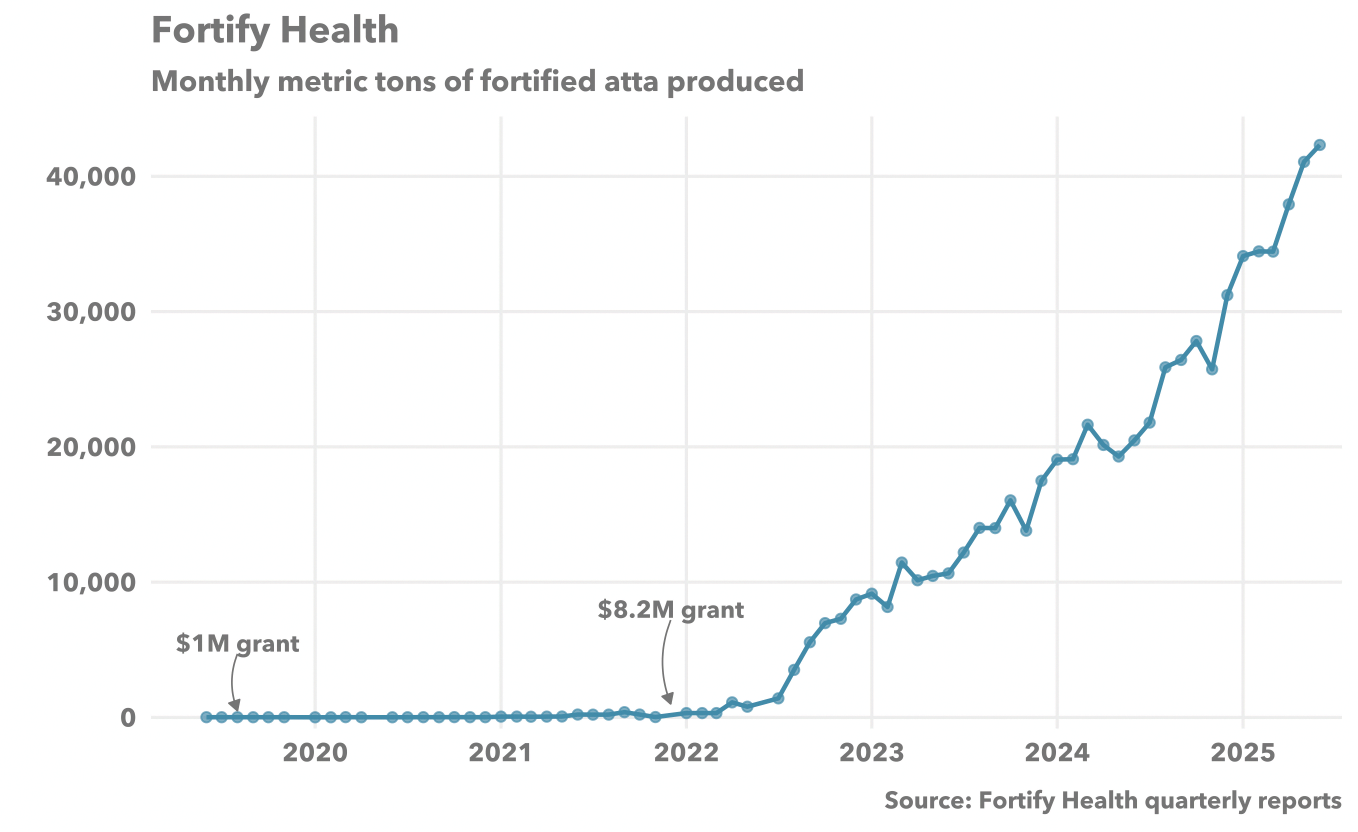
- Looking back at Fortify Health’s progress: Fortify Health partners with wheat flour mills in India to fortify flour with iron and other micronutrients. After earlier grants to Fortify Health providing general support, GiveWell made a larger $8.2 million grant in 2021. At the time GiveWell made this grant, Fortify Health was working with seven mills and reaching roughly 350,000 people per year. Over the next three years, it expanded to 125 open-market mills producing more than 30 times more flour (see chart below) at about half the cost per person reached of our original estimate. We now estimate that our 2021 grant was about twice as cost-effective as we initially projected. Based on this track record, we recently renewed our support to Fortify Health with a $10 million two-year grant.
- What’s next for GiveWell’s research into iron: GiveWell currently supports two iron programs in India: Fortify Health’s work expanding iron fortification of wheat flour and Evidence Action’s iron and folic acid supplementation program for children. To date, GiveWell has not funded iron fortification or supplementation programs in Africa, despite the region’s high anemia burden, in part because of concerns about potential harm from iron interventions in high-malaria settings. To help expand our work in this area, we issued a request for information for iron programs earlier this year—focusing on lower-malaria contexts—and are currently evaluating responses. We’re also considering support for historical research studying countries that have introduced fortification programs to help assess the long-term income effects of providing iron.
GiveWell’s research on iron supplementation and fortification programs exemplifies this moment in GiveWell’s evolution: The research capacity and track record we’ve built are now enabling us to assess past grants, build and evaluate the evidence base, and expand our support of new cost-effective ways to help people in need.
Visit our All Grants Fund page to learn more about how you can support this work, and listen or subscribe to our podcast for our latest updates.
This episode was recorded on May 15, 2026 and represents our best understanding at that time.