
Every month we send an email newsletter to our supporters sharing recent updates from our work. We publish selected portions of the newsletter on our blog to make this news more accessible to people who visit our website. For key updates from the latest installment, please see below!
If you’d like to receive the complete newsletter in your inbox each month, you can subscribe here.
Our Growing Impact
Last year, GiveWell raised $616 million and directed $427 million to programs in 32 countries. That was our largest fundraising year to date, and we’re now preparing for the potential of a future at a substantially larger scale. We’ve already directed over $600 million in 2026 to help people in need, and thanks to the generous support from our donors, we think our grantmaking may approach or even exceed $1 billion this year.
We recently published our 2025 metrics report, which covers both our fundraising and the impact we had with the donations we received. In total, we expect the programs we funded will save about 86,000 lives.
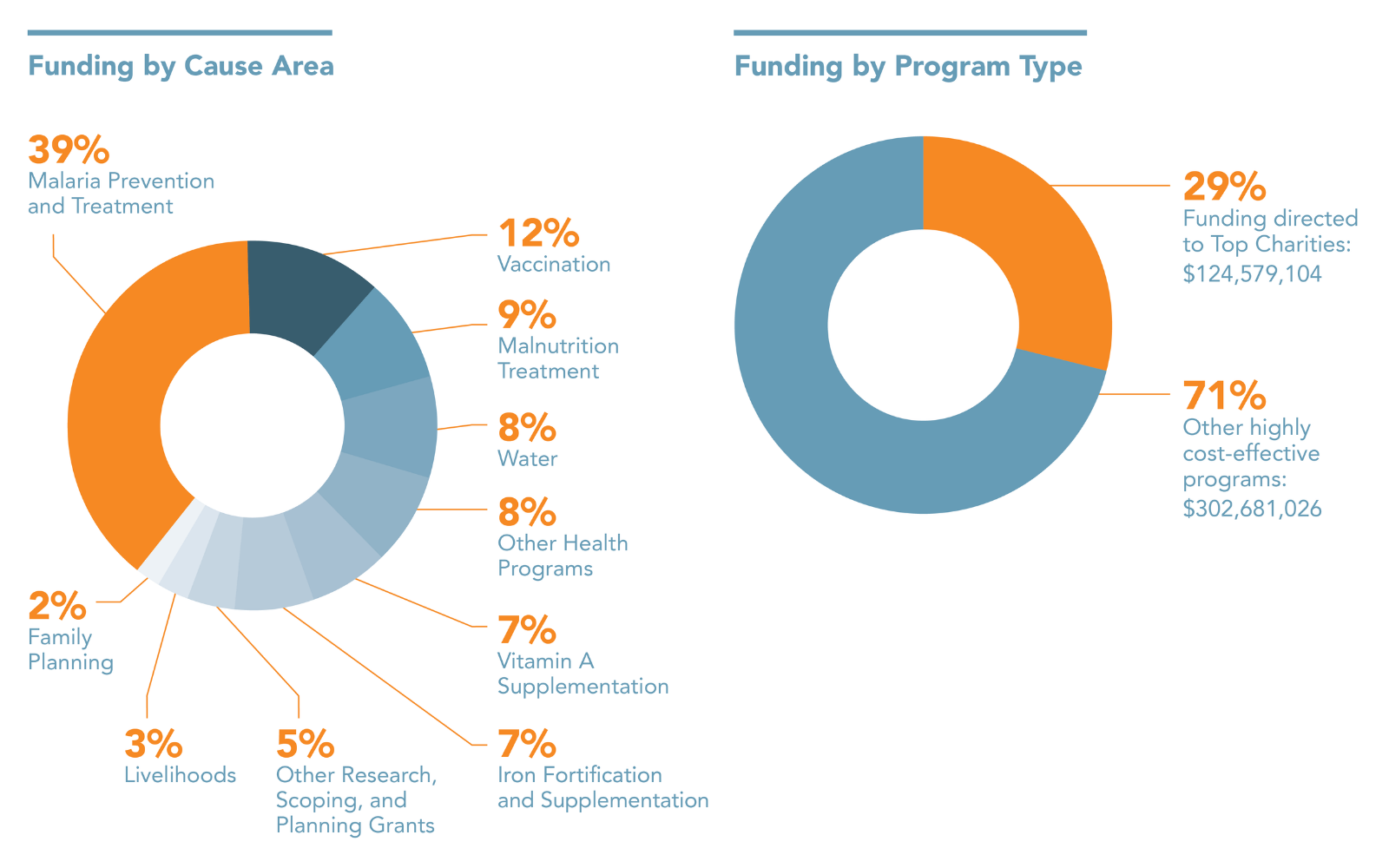
Despite the growth of our grantmaking, the needs and opportunities before us continue to far exceed available resources. More than four million young children die in low- and middle-income countries every year, and most of those deaths are preventable.1Our World in Data, “Number of child deaths,” 2024, shows 1.60 million deaths of children under five in low-income countries and 2.73 million in lower-middle-income countries, totaling 4.33 million in 2024. World Bank Group, “Mortality rate, under-5 (per 1,000 live births)” shows a mortality rate for children under five of 40.8 for low- and middle-income countries and a child mortality rate of 5.1 for high-income countries in 2024. If children under five in low- and middle-income countries were to die at the child mortality rate of high-income countries rather than at their current rate, representing the potential effect of high-income country conditions existing across low- and middle-income countries, 87.5% of child deaths in low- and middle-income countries would be averted: 5.1 / 40.8 = 12.5%, or 1 − 0.125 = 87.5% percent averted. We are growing our team to investigate and fund promising programs at a scale we haven’t previously been able to pursue—and we continue to invite donors to help us.
Over the past two years, we’ve increased our research team from 38 people to 85, and we’re continuing to hire across the organization. That increased capacity lets us explore more areas and move more funding to programs we believe could do extraordinary good. We’re going deeper in areas we know well, such as malaria—where we expect to direct nearly three times as much funding this year as we did last year. We’re also pursuing new approaches, including partnerships that could reach many more people quickly and grants that generate the evidence we need to guide future funding decisions.
You can learn more about GiveWell’s expansion efforts, what’s driving our growth, how we’re scaling our impact, and recent examples of our progress in the new “Growth and Expansion” section of our website, which we’ll be updating as this work progresses.
GiveWell’s CEO Speaks at Devex Impact House
During UN General Assembly week, GiveWell co-founder and CEO Elie Hassenfeld joined Devex Impact House for a conversation about how to direct more funding toward opportunities to save and improve lives.
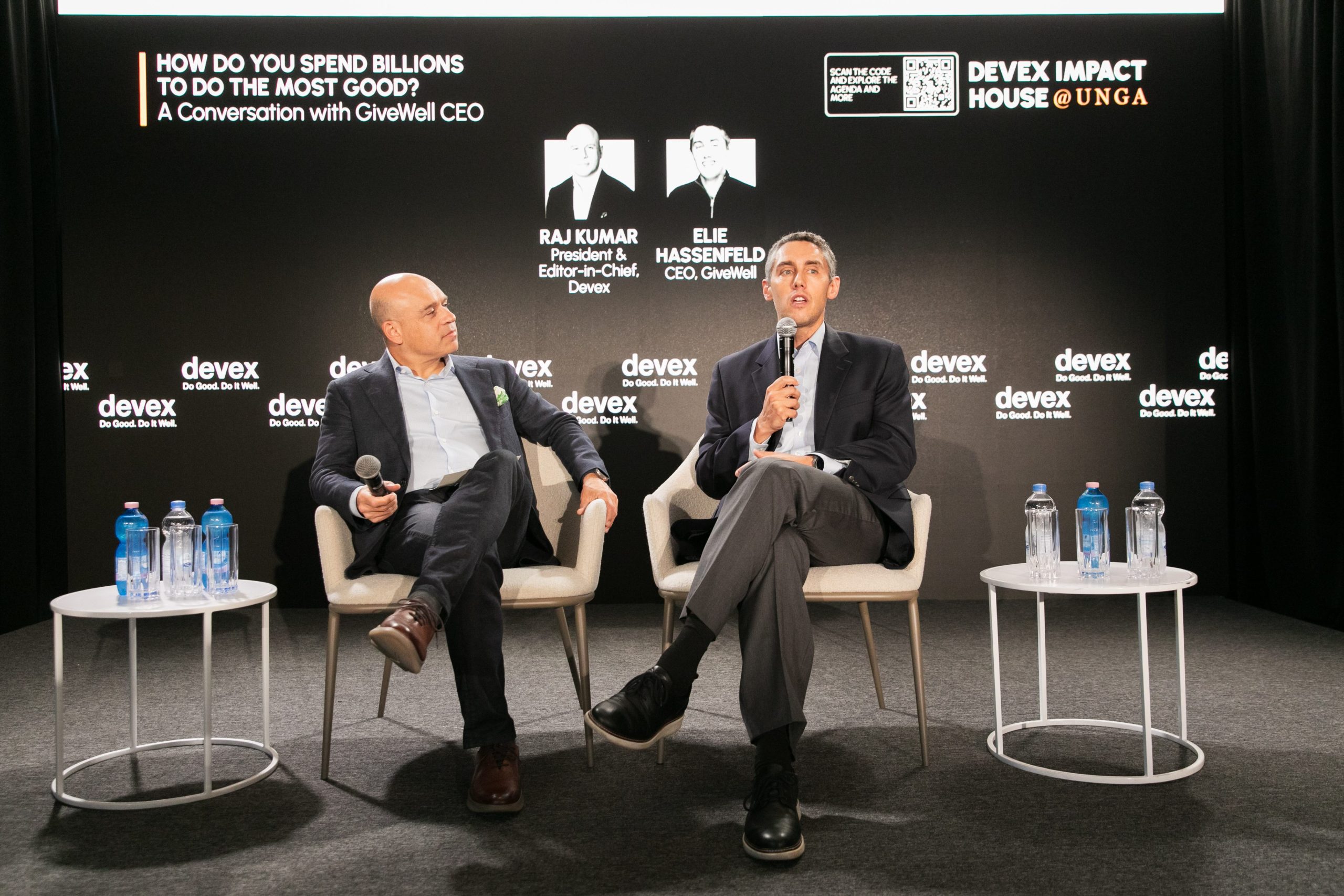
Elie discussed how GiveWell decides which programs to fund, how we’re preparing for a potential increase in philanthropic giving, and why truth-seeking and transparency remain central to our approach. He also described how our grantmaking has expanded to include programs whose impact is harder to measure and how we’re building learning and evaluation into more of our grants.
Watch the event recording or read Devex’s coverage of the conversation.
Pressure-Testing Our Research as GiveWell Grows
GiveWell’s Cross-Cutting research subteam focuses on improving our grantmaking over time—it investigates the impact of the programs we fund, works to resolve our largest uncertainties, and strengthens our data collection and analysis.
In our recent podcast episode, GiveWell co-founder and CEO Elie Hassenfeld speaks with Program Director Alex Cohen, who leads the Cross-Cutting subteam, about how better data can improve our decision-making, how we’re working to gather stronger evidence, and how we’ve tested AI as a tool to increase our research capacity and quality.
Grant Spotlight
Our grantmaking aims to support programs that save or improve lives the most per dollar. Here’s a look at one recent example:
Where: Up to 54 low- and middle-income countries
What: Procurement of contraceptives and other reproductive health commodities
Who: UNFPA Supplies Partnership
Total: $10 million
How it works: The United Nations estimates that 165 million women aged 15 to 49 worldwide have an unmet need for family planning, meaning they want to avoid or delay pregnancy but are not using contraception. The UNFPA Supplies Partnership pools funding from multiple donors to buy contraceptives and other reproductive health supplies in bulk, then allocates them across its 54 focus countries. This grant will primarily be used to fund those purchases over two years.
Why this grant: Gaps in the global supply of family planning products are large and growing, and we expect this funding to make more contraceptives available to people who want them. This is also our first grant through a pooled fund, and we expect to learn whether this model could be an effective way to direct funding at a larger scale.
Funded by: Coefficient Giving
To learn more, read the grant page.
Hiring Announcements
Featured Roles: Senior Communications Officers
We’re hiring three Senior Communications Officers to build and lead our communications function. These roles will be the first of their kind at GiveWell, and we are looking for exceptional leaders who can help set the standard for how we operate.
- Senior Communications Officer, Strategic Communications: Lead GiveWell’s development of messaging and narratives that explain its work across different audiences and contexts.
- Senior Communications Officer, Media & Public Affairs: Lead how GiveWell’s work is represented in the media and in public conversations.
- Senior Communications Officer, Editorial & Production: Lead the editorial quality and production of GiveWell’s communications.
If you’re an experienced communications professional with expertise in one of these areas and are excited to help build the communications capacity GiveWell needs for its next stage of growth, we’d love to hear from you.
We have several other newly opened positions—if you know someone who might be a good fit, please share the relevant link and encourage them to apply.
- Head of Legal
- Senior Recruiter, Research
- Cause Prioritization Lead (apply by Oct 30)
- Senior Program Officers
- Senior Researchers (subteam-specific roles available)
Visit our Jobs page to see all open positions.
Partner Roundup
- Celebrate the Against Malaria Foundation passing $1 billion raised, a milestone made possible by more than 1.6 million donations from 253,000 people, with our recent $276 million grant taking it past the mark.
- See how Helen Keller Intl built vitamin A supplementation into routine clinic visits in rural Nigeria to better reach children missed by periodic campaigns.
- Watch New Incentives’ Operations Director discuss what it takes to strengthen routine immunization in northern Nigeria.
Comments or Questions?
We’re always looking for fresh perspectives on our research. If you have comments or questions about our work, we want to hear from you! Reach out to us at info@givewell.org.
Notes
| ↑1 | Our World in Data, “Number of child deaths,” 2024, shows 1.60 million deaths of children under five in low-income countries and 2.73 million in lower-middle-income countries, totaling 4.33 million in 2024. World Bank Group, “Mortality rate, under-5 (per 1,000 live births)” shows a mortality rate for children under five of 40.8 for low- and middle-income countries and a child mortality rate of 5.1 for high-income countries in 2024. If children under five in low- and middle-income countries were to die at the child mortality rate of high-income countries rather than at their current rate, representing the potential effect of high-income country conditions existing across low- and middle-income countries, 87.5% of child deaths in low- and middle-income countries would be averted: 5.1 / 40.8 = 12.5%, or 1 − 0.125 = 87.5% percent averted. |
|---|