
Over the past five years, GiveWell has expanded the scale of our grantmaking and team substantially. We expect to grant more than $1 billion this year, more than double the $418 million we committed in 2025. Alongside this grantmaking growth, we’ve more than doubled the number of researchers on our team since the start of last year. A larger team means we can investigate a greater number of both more complex and larger funding opportunities than we could before. One area where we expect our grantmaking to increase substantially in the coming years is the prevention and treatment of malaria.
From 2027 through 2032, we’re aiming to grant at least $2.5 billion in new malaria funding, potentially several times that amount. The total amount will depend on the funding we have available, the feasibility of scaling up cost-effective malaria programs, countries’ appetite for those programs, and how opportunities within malaria compare to other grantmaking areas. This expanded support could go to organizations we currently fund (such as the Against Malaria Foundation and Malaria Consortium), as well as to new organizations and novel funding vehicles. We are still in the process of assessing which strategies for deploying new malaria funding are likely to be highly cost-effective and scalable, and are currently exploring partnerships with the Global Fund and Gavi to help rapidly scale our impact across many programs in many countries at once.
While this post focuses on our malaria work, we are also growing our grantmaking in other areas. This includes areas we have supported for many years, such as treatment for severe malnutrition, efforts to increase childhood vaccination, and programs to provide safe drinking water, as well as areas we have supported at relatively smaller scale to date, such as medical oxygen, tuberculosis control, and family planning. We currently expect to grant more than $1 billion to program areas outside malaria in 2027, and we think we could grant more with additional funding. While the scale of our grantmaking is growing, we’ll remain focused on researching the most cost‑effective ways to save and improve lives, sharing our work openly, and directing donations to help people in need as much as we can.
- Why malaria?
- What and how much might we fund?
- How long will we fund programs?
- The Malaria Impact Accelerator partnership with the Global Fund
- Building the data to scale well
- What we’re working on and what comes next
Why malaria?
Malaria kills around 600,000 people each year, most of whom are young children.[1] We know how to prevent, diagnose, and treat malaria. Effective prevention can be provided via vector control (especially long-lasting insecticide-treated nets), chemoprevention, and vaccination.[2] Inexpensive rapid diagnostic tests can be used to identify when people have been infected with malaria,[3] and artemisinin-based combination therapies (ACTs) or injectable artesunate are highly effective treatments.[4] However, many people in countries where malaria is endemic do not have access to prevention and treatment.[5]
Governments of malaria-endemic countries fund a substantial part of their own malaria responses,[6] but in many high-burden countries, domestic budgets alone cannot cover what is needed. In addition, recent declines in health aid have widened gaps that already existed. Donors pledged $12.6 billion for the Global Fund’s latest replenishment, down from $15.7 billion three years earlier and well short of the $18 billion target.[7] As a result, the Global Fund has allocated $3.5 billion to countries for its next three years of malaria grants, about 15% less than in the previous three-year cycle.[8] Gavi, which funds malaria vaccines, raised just under $10 billion of its $11.9 billion budget for 2026–2030 and reduced the malaria vaccine coverage it will fund as a result.[9] At the same time, newer tools that could drive significant advances, such as dual-ingredient nets designed to counter insecticide resistance, cost more than older ones.[10]
Malaria control has long been a central focus of our work. In total, GiveWell has directed more than $1.3 billion to malaria prevention and treatment, including more than $750 million for nets and more than $500 million for seasonal malaria chemoprevention (SMC), which we estimate will save more than 300,000 lives.
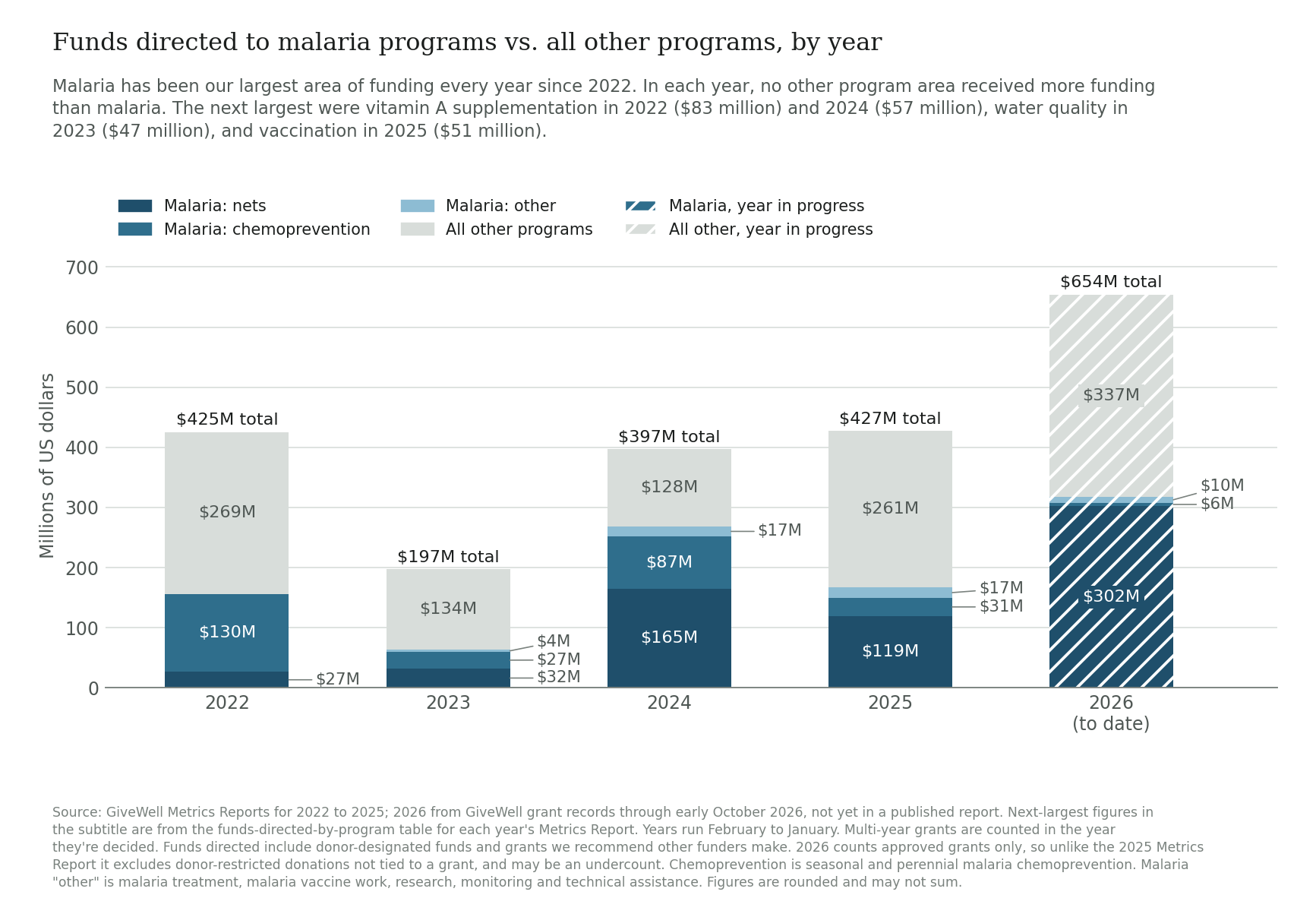
Malaria stands out among the areas we’re exploring for expanded grantmaking because such large funding gaps exist for programs that have strong evidence of effectiveness and that GiveWell has experience funding. This contrasts with other grantmaking areas we’re exploring, where we’re earlier in our understanding. We expect to make more grants and larger grants in some of these other areas as we learn more about them.
What and how much might we fund?
To identify programs[11] we might fund through our expanded malaria portfolio, we looked for those that have evidence of reducing illness and death, are feasible to deliver where malaria is most common, and could fit with national priorities. We’ve also focused our analysis to date on programs where we expect the largest funding gaps to exist, since those areas could make the biggest difference to how much funding we allocate.
Based on this initial work, we see room for at least $2.5 billion in grantmaking to malaria programs from 2027 through 2032 at our current cost-effectiveness bar (you can read more about the role of cost-effectiveness in our funding decisions). With more funding, we could grant substantially more, potentially at a lower cost-effectiveness bar.
Our early expectation is that most of this funding could go to support the programs below. The list focuses on programs that could be both cost-effective and have large funding gaps.[12]
Note, however, that this list is neither comprehensive nor final. We expect to update the list of potential programs over time and to update our view of the programs listed as we do more research and learn from national malaria programs and other implementers.
- Prevention programs, such as insecticide-treated nets, seasonal malaria chemoprevention (SMC), and malaria vaccines, including running these programs more often or reaching people these programs do not currently cover.
- Testing and treatment programs and commodities, such as case management by community health workers, and support for supply chains that transport diagnostic tests and treatment drugs to clinics.
- Newer tools, such as spatial emanators and insecticide-treated babywraps, provided they are supported by sufficient high-quality evidence. We expect to fund some of that evidence generation ourselves, including additional randomized trials.
The technical notes for each program summarize our current understanding and uncertainties. Overall, we’re more confident in our understanding of net campaigns and SMC for young children, which we’ve funded at a large scale for years now. We’re still developing our understanding of the cost-effectiveness of approaches like supporting community health workers and support for supply chains, chemoprevention for older children, and efforts to increase coverage of the malaria vaccine and newer tools at scale.
The most cost-effective mix of programs will also vary from place to place. For example, a given program may be highly cost-effective where malaria is common, the program is feasible to implement, and few people have alternative sources of malaria prevention, and much less so where the reverse is true.
Alongside multiyear grants for these programs, we expect to fund supporting work such as monitoring and evaluation, evidence generation, operational research, market shaping, technical assistance, advocacy, and possibly research and development.
GiveWell uses a cost-effectiveness threshold that helps us decide whether to provide funding to a program. We currently fund programs that are at least 6 times more cost-effective than our benchmark. We have rough projections of how much malaria funding we could grant at different levels of cost-effectiveness, but these are early estimates that we expect to change substantially as we do more research and learn from national programs and implementers about which programs they want to prioritize and can deliver well. In the future, the threshold we use to make funding decisions may change depending on how much funding we raise and what outcomes we believe can be achieved.
How long will we fund programs?
We’re working to secure the resources needed to support these programs for five to six years. We think this will let us fund more cost-effective programs more quickly. Expanding a malaria program takes upfront work, like planning, hiring and training staff, and setting up operations in new locations. In our experience, national programs and other implementers are more willing to take that on if they expect funding to last long enough for the work to pay off. With only a short funding period, many would reasonably expand less, leading to less impact.
A longer time frame also means we can act on the evidence we help build. We expect to fund studies of some newer tools. If evidence shows a tool works and can be delivered well, we want to have funding ready to deliver it at scale, ensuring the evidence translates quickly into impact.
Our intention is to renew the initial grants, which will likely cover about two to three years of programming, and we plan to set aside the funding to continue programming when we make initial commitments. Before renewing, we will consider whether governments are interested in continuing the programs and whether they’re having the expected outcomes (e.g., whether coverage surveys show they’re reaching the people they’re meant to, and whether malaria prevalence is falling in the areas they cover). Many of the programs we’re considering are ambitious and new at this scale, such as running net campaigns more often or extending chemoprevention to older children, and we, alongside national programs and other implementers, expect to learn a lot in the first few years about what works. We’ll also consider whether other funding for malaria programs has gone down, because we intend for our funding to add to what governments and other donors already spend, not replace it.
If we decide to reduce or end funding after an initial grant, we plan to give national governments and other implementers as much notice as we can and to step funding down gradually. As we do with our existing grantees, we expect to provide exit funding to allow for a well-managed wind-down. Where we can, we’ll also design programs so that governments or other funders can more easily continue them.
The Malaria Impact Accelerator partnership with the Global Fund
The Malaria Impact Accelerator is a proposed partnership between GiveWell and the Global Fund, and one of several ways we are considering directing our expanded malaria funding. It would build on the Global Fund’s processes, with a few key differences.[13] First, the funding through this partnership would be specific to malaria[14] and allocations to countries through this partnership would be more proportionate to malaria burden than the Global Fund’s core allocations. As a result, in comparison to the Global Fund’s typical processes, we expect funds allocated through the Malaria Impact Accelerator will go to a smaller number of higher burden countries. Additionally, the funding would only support programs we assess to be above our cost-effectiveness bar. We would also fund independent monitoring of these programs and publish the results.
The proposed Malaria Impact Accelerator has three main components: (1) country “investment requests,” which are plans countries would submit for how they would use additional funds, (2) a “fast track” for urgent needs, and (3) funding for complementary work.
We expect most funding in the Malaria Impact Accelerator to support country “investment requests,” giving countries additional funds to support their national malaria priorities. GiveWell and the Global Fund would jointly set a maximum funding allocation for each eligible country and provide guidance on which programs are eligible and how cost-effectiveness will shape funding decisions. We would also fund technical support for countries that want it in preparing their requests. Each country, operating through existing Country Coordinating Mechanisms,[15] would choose the programs it wants to include in its investment requests based on its own priorities, including those in its National Strategic Plans. Requests would be reviewed by the Global Fund’s existing Technical Review Panel for technical soundness and by GiveWell for cost-effectiveness, and countries would have an opportunity to revise requests in response to feedback before GiveWell and the Global Fund’s final joint funding decisions.[16]
Because these requests take time to prepare and review, we also expect to run a “fast track” to fund urgent gaps countries have already identified as priorities in highly cost-effective programs.
Finally, we expect to set aside some funding for complementary work that doesn’t fit within a single country’s request. This funding could support bringing new tools to market, making tools more affordable, or generating evidence on questions that help us make better funding decisions.
Why the Global Fund
We think partnering with the Global Fund is the fastest way to scale up malaria funding, reduce malaria burden, and support national malaria responses. The Global Fund is the largest international funder of malaria programs, disbursing roughly $1 billion to $1.5 billion a year for malaria over the past decade.[17] It has long-standing relationships and established funding processes in the countries where malaria burden and funding gaps are highest. Working within those processes means countries won’t need an entirely separate process to work with us. In addition, the Global Fund has financial controls and an independent audit office to help prevent fraud and waste.
We’ll decide how much to grant through the Malaria Impact Accelerator as we do more research on the funding opportunities, see applications from countries, and get more information from the Global Fund. However, there are a few considerations that could lead us to grant less than expected through this mechanism, or none at all:
- The Global Fund’s commitment and capacity. The Global Fund’s board has yet to approve the mechanism. It will soon select a new executive director and seat its recently elected board leadership. The partnership depends on sustained commitment from Global Fund leadership and on the Global Fund executing well. We expect to contribute funding to the Secretariat’s operations, including dedicated staff capacity to support this, and we’ll be watching for continued engagement through the duration of the partnership.
- Track record of Global Fund-funded programming. We want to understand how many people Global Fund-supported programs reach and where coverage could be improved. To do this, we’re funding independent coverage surveys and qualitative research after recent campaigns, and triangulating with coverage surveys from other sources where possible. If coverage appears lower than we expect and difficult to improve, we may grant less funding through the mechanism.
- What we learn from countries. Once we tell a country its maximum funding amount, that funding will be available for requests that meet our cost-effectiveness bar. As countries plan and submit investment requests, we may find that interest in some programs we think are highly cost-effective is lower than we expected, or that they are harder to deliver at scale than we expect. This could lead GiveWell to grant less funding overall or similar amounts at a slower pace.
- Longer-term risks. Increased philanthropic funding could lead governments and other donors to cut their own malaria spending, or could strain health systems. We plan to engage with governments and donors to emphasize that our funding is intended to be additional to theirs, and that its impact depends on their continued vital investments. We’re exploring matched funding and advocacy to encourage them to sustain their spending. We also expect to fund health systems investments that support malaria programs, and to monitor whether other care is affected. If we think there is likely to be substantial risk of crowding out or negative spillovers to the broader health system that we are unable to mitigate, it could cause us to grant less funding.
In the event we direct less funding than expected or no funding through this partnership with the Global Fund, we would plan to scale up malaria funding through other grantees, including organizations we fund today.
Building the data to scale well
We plan to fund additional data collection, monitoring, and strengthening of existing data systems so that national malaria programs, other implementers, and funders, including GiveWell, have better information for their decisions. We think these efforts could help answer key questions for both malaria and non-malaria programs:
- Where should funding be targeted and for which programs?
- What opportunities are there to improve the quality of implementation?
- How can GiveWell estimate the impact of our funding?
Where should funding be targeted, and for which programs?
Decisions about where to direct resources for malaria programming mostly rely on routine health facility data, which can be inaccurate in areas with a high malaria burden,[18] and on national household surveys that run every few years at best.[19]
With national malaria programs’ agreement and collaboration, we plan to fund nationally representative household surveys in countries where we may grant substantial additional funding, to be completed prior to our key funding decisions, and to strengthen the routine data that national programs collect from health facilities and hospitals. Together, these should give better estimates of malaria prevalence, severe malaria, child mortality, and program coverage. Some of the same data will also be useful for other programs. For example, the household surveys will ask whether children received vitamin A supplements in the past six months. This could give health ministries additional information on where supplementation is hitting coverage targets and where more support might be needed. We also expect to fund monitoring of drug and insecticide resistance and of mosquito populations. Current monitoring has significant geographic gaps, and resistance can make programs less effective over time.[20]
Better data would help in tailoring programs to local conditions, identifying emerging risks to program efficacy, and directing newer tools to the areas that need them.
What opportunities are there to improve the quality of implementation?
Many health programs report the number of people reached from implementers’ own records, which raises concerns about data completeness, data quality, and the potential for bias. We expect to fund independent household coverage surveys, which estimate what share of the eligible population was reached, and visits to a sample of people recorded as receiving services to check that they did.
We think that funding to strengthen existing data collection systems can help implementers identify and fix implementation issues while programs are running. For example, an unexpected increase in malaria among pregnant women at their first antenatal visit could signal that prevention efforts in that area aren’t reaching people or working as intended. Signs of growing drug or insecticide resistance could prompt a switch to a different drug or type of net. Finally, we will explore support to other modes of learning about program implementation such as community-led monitoring.
How can we estimate the impact of our funding?
Most estimates of the impact of large health programs, including GiveWell’s, are modeled or extrapolated using data from administrative systems, infrequent surveys, and/or older trials run in different settings and at smaller scale. We’re considering two approaches that may allow us to more directly measure the impact of increased malaria funding on prevalence and mortality.
- We could compare changes in prevalence and mortality between areas that receive more of our funding and areas that receive less, and treat the difference as the effect of our funding. This gives a causal estimate if the two sets of areas would have changed in the same way without our funding. To make it more likely this assumption holds, we would likely restrict the comparison to the most similar areas.
- We could use the way individual programs are rolled out to compare similar groups that do and do not receive the program. For example, chemoprevention programs typically target only certain ages, so we could compare children just above and below that limit to estimate program impact. These comparisons are more credibly causal, but each one covers only a small part of what we fund and misses how programs work in combination.
We will adapt our approach to data collection over time as we further define our scaling plans and learn more from governments and other implementers. Some specific uncertainties include:
- Specific support for national malaria control programs and implementers. We’re eager to learn from national malaria programs and implementers about how best to ensure that these efforts can be used to help with planning and program improvements. We know that one strategy is to share results using systems and formats they already use. Over the next few months, we expect to share results from data collection we’re already funding and will work to learn more about the best ways to support governments and implementers in using these data and to strengthen existing data systems.
- Timing. It’s possible that some of the surveys we plan to fund may not generate findings prior to the funding decisions we intend them to inform. While this would reduce their usefulness for that purpose, the data could potentially be used to inform governments and other implementers. In addition, if we think surveys could not be completed in time to inform particular decisions, we may choose to spend less on them.
- Attribution of impact. We may not be able to attribute changes in malaria or mortality to our funding. Doing so depends on comparable regions receiving funding at different times or intensities, which we may not control. We are also likely to be underpowered to detect effects on mortality for several years.
- Sustainability of these data systems. Countries may not want or be able to keep paying for these data if our funding ends. We’re exploring ways to test cheaper methods that would be easier to sustain without external support (such as phone surveys, data gathered during routine health facility visits, and prediction models) against more expensive data collection techniques, such as in-person household surveys.
What we’re working on and what comes next
As with the rest of our grantmaking, we expect our malaria plans to evolve as we learn from new research, from conversations with governments and other partners, and from new data collected from the programs we fund. To drive this work forward, in the coming months we expect to:
- Update our understanding of the cost-effectiveness of programs and real-world funding gaps. By reviewing published research and having conversations with experts at all levels, national malaria programs, and our partners, we’re working to deepen our understanding of the impact and cost-effectiveness of specific programs we could fund. We are also working to better understand which programs are already funded and where gaps remain in the countries where we expect to fund the most.
- Fund immediate gaps that we know about. Some countries have already planned highly cost-effective programs, such as net campaigns, that they can’t pay for. We expect to support these programs in whichever way makes the most sense. This may mean approving grants to the Against Malaria Foundation or Malaria Consortium, two of our current grantees; funding the programs through the Malaria Impact Accelerator’s fast track; or potentially funding other implementing organizations.
- Fund baseline data collection. With national programs’ approval, we expect to fund household surveys in countries where we may end up directing the most funding. These would measure malaria prevalence, child mortality, and program coverage before funding scales up. We’re also finishing the review of coverage surveys of recent Global Fund-supported campaigns described above.
- Take the next steps on new partnerships. If the Global Fund’s board approves the Malaria Impact Accelerator mechanism and we decide to move forward with the partnership, we expect to work with Global Fund staff to set country allocations, publish the guidance described above, and begin funding technical support for countries that want it. At the same time, we’re exploring partnerships with other organizations, including funding malaria vaccines through Gavi, which could help us reach more people with cost-effective malaria programs.
We’ll keep updating our plans as this work progresses, and we plan to share what we learn along the way.