
Every month we send an email newsletter to our supporters sharing recent updates from our work. We publish selected portions of the newsletter on our blog to make this news more accessible to people who visit our website. For key updates from the latest installment, please see below!
If you’d like to receive the complete newsletter in your inbox each month, you can subscribe here.
Our 2025 Grant Investigation Survey Results
When we investigate potential grants, we work closely with implementing organizations—gathering data, asking detailed questions, and assessing cost-effectiveness. Sometimes this results in us making a grant, and other times it doesn’t, but we want to ensure our process always reflects our core values of truth-seeking and transparency. So, for the second year in a row, we sent an anonymous survey to find out how we’re doing.
The survey was sent to organizations that participated in our grant investigation process from April 2024 through July 2025. We invited 122 individuals representing 75 organizations to participate—more than double last year’s sample—and we received 80 responses (a 66% response rate). Included in the total were 22 contacts from investigations that did not result in a grant, from which we received five responses.
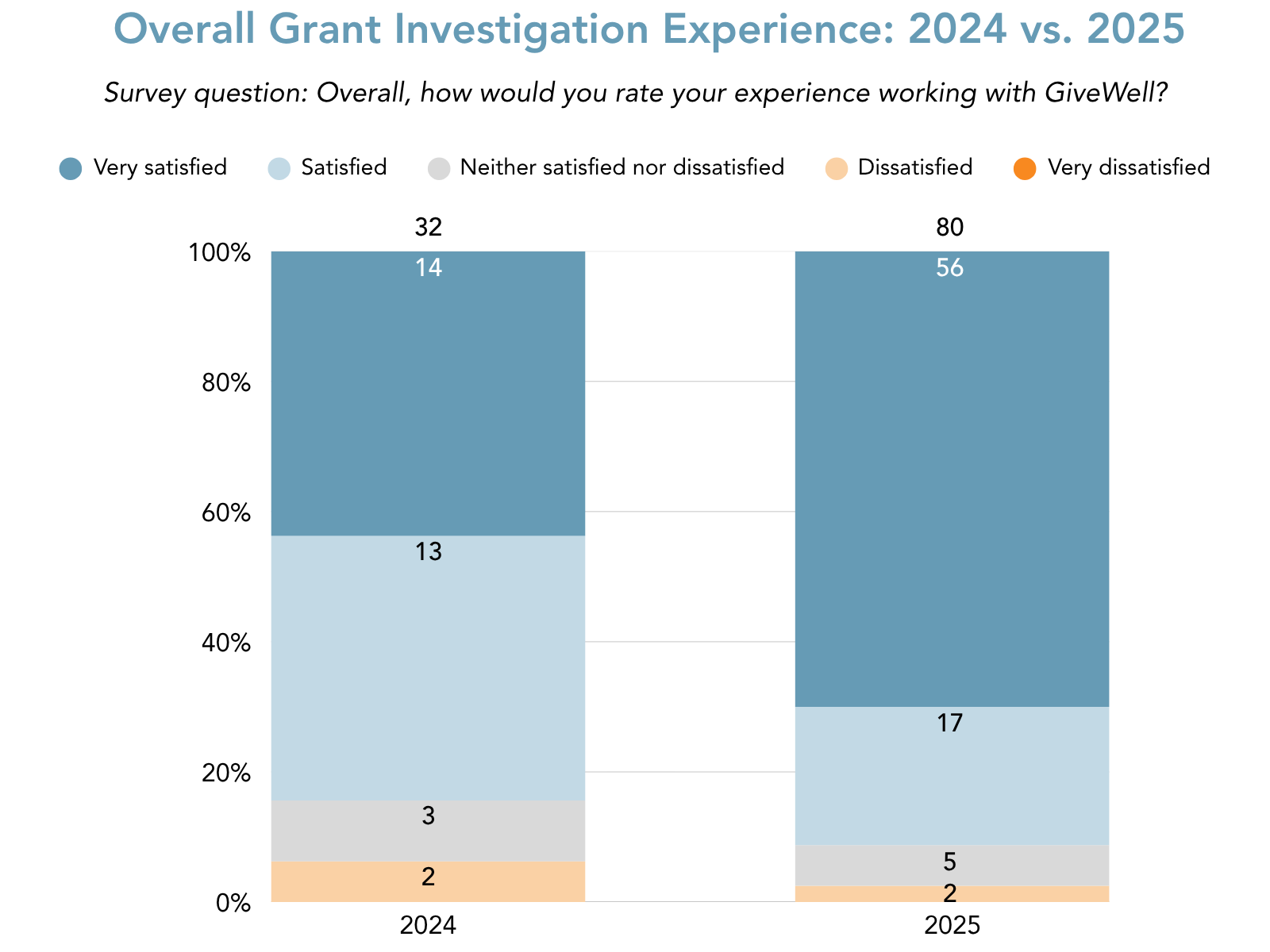
The results were encouraging: overall satisfaction rose from 4.2 to 4.6 out of 5, with particularly high marks for honest communication and treating organizations as experts in their work. We also saw new themes emerge this year. Several respondents said they gained value from GiveWell beyond funding, through shared data from similar programs, connections to other implementers, and monitoring and evaluation guidance. Others appreciated our responsiveness during the US foreign aid freeze and resulting uncertainty.
The survey also pointed to areas we need to improve, including being clearer about why we’re asking for specific information, doing more to share what we’re learning with partners, and building a mutual understanding of monitoring and evaluation best practices. We’re actively working on these areas and plan to conduct the survey again in 2026 to track our progress. To learn more, check out our blog post.
Investing in Information for Greater Future Impact
In addition to our core grantmaking, GiveWell is funding an increasing number of grants designed to generate information that will help us direct more funding to highly cost-effective programs in the future. In 2025, we made 18 grants totaling approximately $39 million aimed specifically at improving future funding decisions.
In our latest podcast episode, GiveWell CEO and co-founder Elie Hassenfeld speaks with Program Director Julie Faller about these “value of information” grants.
Elie and Julie cover:
- Testing variations on cash transfers to improve cost-effectiveness: GiveWell funded GiveDirectly to pilot three variations of its flagship cash transfer program: grants to local businesses, targeted transfers to the poorest young adults, and pairing transfers with footbridge construction. The pilots will help us learn which approaches increase economic impact, potentially leading to more opportunities to help people in need.
- Testing a delivery model for diarrhea treatment: To explore whether door-to-door delivery could increase uptake of oral rehydration solution—an inexpensive, effective treatment for diarrhea-related dehydration—GiveWell funded a large randomized controlled trial with the Clinton Health Access Initiative in Bauchi, Nigeria. Initial results are promising, and we’re now considering whether to fund this model at scale.
- Collecting better data on a nutrition program in India: Fortify Health works to address widespread anemia in India by partnering with flour millers to fortify wheat flour with iron. GiveWell funded a household survey in six Indian cities to better understand how much fortified flour people are actually consuming, helping resolve some uncertainty about the program’s cost-effectiveness and inform our decision to renew funding.
Read our episode summary for more, and subscribe to be notified of our newest episodes.
Following the Data on Dispensers for Safe Water
As our research team has grown, we’ve become better able to collect and analyze data on how our grants are performing. When early data on Evidence Action’s Dispensers for Safe Water program suggested it might not be reaching as many people as estimated, we dug in deeper—funding independent surveys, supported by donations to the All Grants Fund, to understand why.
In a recent podcast episode, GiveWell CEO and co-founder Elie Hassenfeld and Senior Program Officer Erin Crossett discuss what the surveys revealed, how we changed course, and what those findings mean for our broader approach to monitoring.
Grant Spotlight
Our grantmaking supports programs and research that aim to save and improve lives the most per dollar. Here’s a look at one recent example:
Where: Niger State and Bauchi State, Nigeria
What: Vitamin A supplementation (VAS) to reduce childhood deaths from infectious disease, delivered alongside preventative malaria medication campaigns
Who: Malaria Consortium
Amount: $410,000 top-up, totaling $1.8 million
How it works: This grant supports the delivery of VAS alongside Malaria Consortium’s existing door-to-door seasonal malaria chemoprevention (SMC) campaigns, reaching children aged 6 to 59 months with two life-saving interventions at once for a very low additional cost.
Why this grant: We originally recommended a $1.4 million grant to Malaria Consortium in October 2023 to layer VAS onto existing SMC campaigns as a cost-effective model for reaching children at scale. In May 2025, we learned that the VAS + SMC campaign was at risk after SMC budgets were reduced. We recommended the $410,000 top-up grant to allow Malaria Consortium to proceed with the campaign in Niger State as planned.
Funded by: Donations to GiveWell’s All Grants Fund and an individual donation
To learn more, check out the grant page.
Partner Roundup
- Learn how a health worker in Madagascar is overcoming barriers to reach children with vitamin A through Helen Keller Intl’s program.
- Celebrate New Incentives’ 2025 impact—more than 1.8 million infants enrolled and over 9 million cash incentives disbursed for childhood vaccinations in Nigeria.
- Meet an SMC supervisor in Togo who helps ensure children receive preventative malaria medication during seasonal campaigns through Malaria Consortium.
Comments or Questions?
We’re always looking for fresh perspectives on our research. If you have comments or questions on our work, we want to hear from you! Reach out to us at info@givewell.org.