
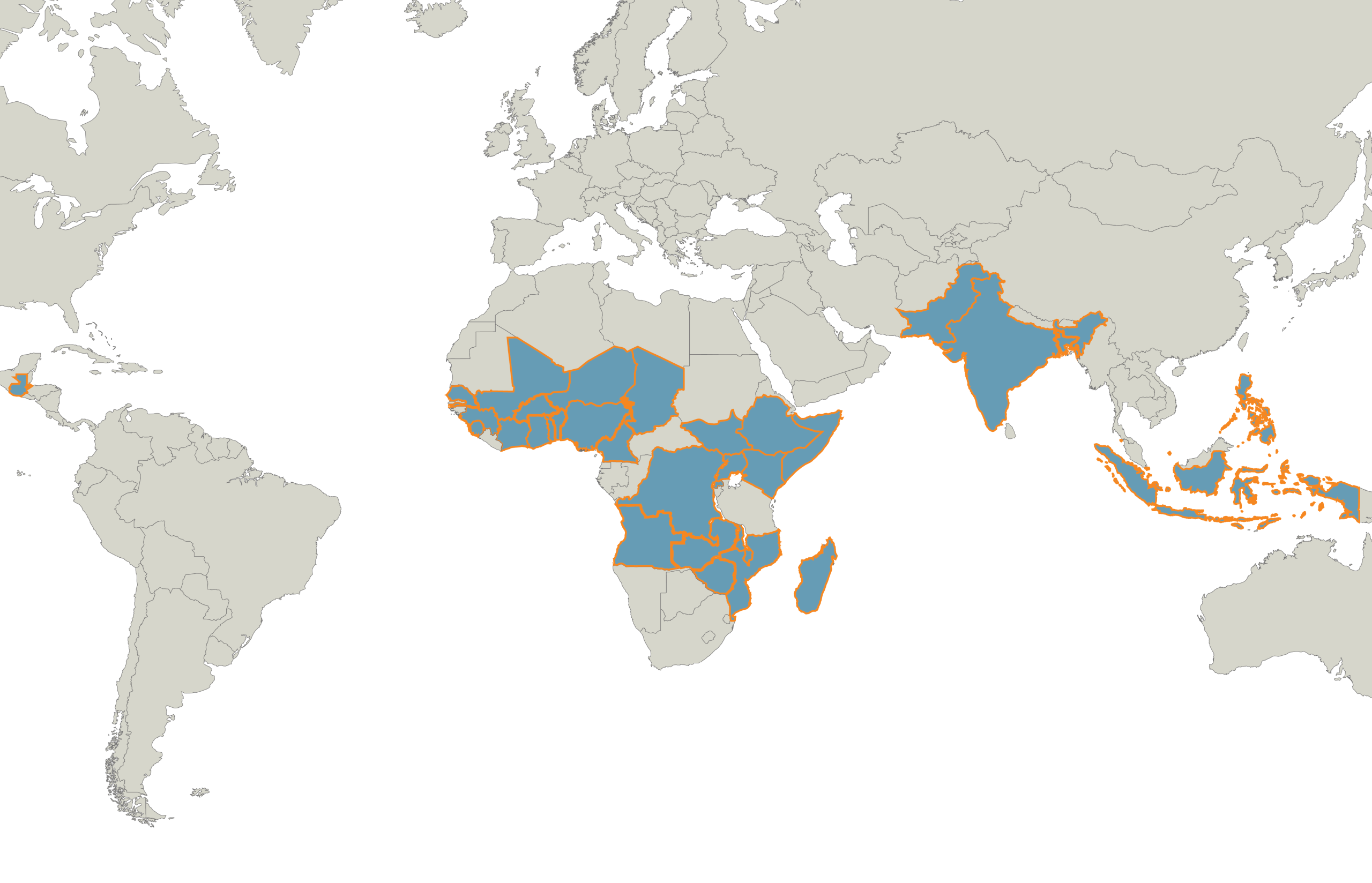
Thanks to the trust and generosity of our donors, GiveWell raised $616 million in metrics year 2025, an increase of 49% from 2024.1GiveWell’s metrics year runs from February 1 through January 31. We directed $427 million to support outstanding opportunities to do good in 32 countries.2The countries include Angola, Bangladesh, Benin, Burkina Faso, Cameroon, Chad, Côte d’Ivoire, Democratic Republic of the Congo, Ethiopia, Ghana, Guatemala, Guinea, India, Indonesia, Kenya, Madagascar, Malawi, Mali, Mozambique, Niger, Nigeria, Pakistan, the Philippines, Rwanda, Senegal, Sierra Leone, Somalia, South Sudan, Togo, Uganda, Zambia, and Zimbabwe. Some 2025 grants were not specific to a country. We estimate that the programs supported by the funds we directed this year will save an additional 86,000 lives.3The calculations for the estimate of lives saved cover only the 2025 grants that had reduced mortality as a primary outcome.
We have spent years growing our research capacity and scope to enable us to direct significantly more funding to the most impactful opportunities we can find, and 2025 was a milestone in that ongoing growth. We responded to urgent needs generated by foreign aid cuts, and we continued to find and fund a growing number and a wider range of high-impact ways to help people. We anticipate our total grantmaking is likely to approach or even exceed $1 billion in 2026, and we are working toward a future that could be several times that scale.
And yet, global needs still far exceed available resources. More than four million young children die in low- and middle-income countries every year—and most of those deaths are preventable.4Our World in Data, “Number of child deaths,” 2024, shows 1.60 million deaths of children under five in low-income countries and 2.73 million in lower-middle-income countries, totaling 4.33 million in 2024. World Bank Group, “Mortality rate, under-5 (per 1,000 live births)” shows a mortality rate for children under five of 40.8 for low- and middle-income countries and a child mortality rate of 5.1 for high-income countries in 2024. If children under five in low- and middle-income countries were to die at the child mortality rate of high-income countries rather than at their current rate, representing the potential effect of high-income country conditions existing across low- and middle-income countries, 87.5% of child deaths in low- and middle-income countries would be averted: 5.1 / 40.8 = 12.5%, or 1 − 0.125 = 87.5% percent averted. As our team works toward our goal of helping people at a much larger scale, we’re grateful to the donors whose support enables us to continue to find and fund highly cost-effective programs that save or improve lives the most.
See our full 2025 metrics report for more details behind the money we raised, the funds we directed, operational expenses, donor metrics, and the impact we had last year.
Funds Raised
We raised more money in 2025 than we have during any previous year, and that was also true for donations to each of our giving funds:
- All Grants Fund: donations of $154 million in 2025, compared to $59 million in 2024
- Top Charities Fund: donations of $126 million in 2025, compared to $64 million in 2024
- Unrestricted Fund: donations of $199 million in 2025, compared to $111 million in 2024
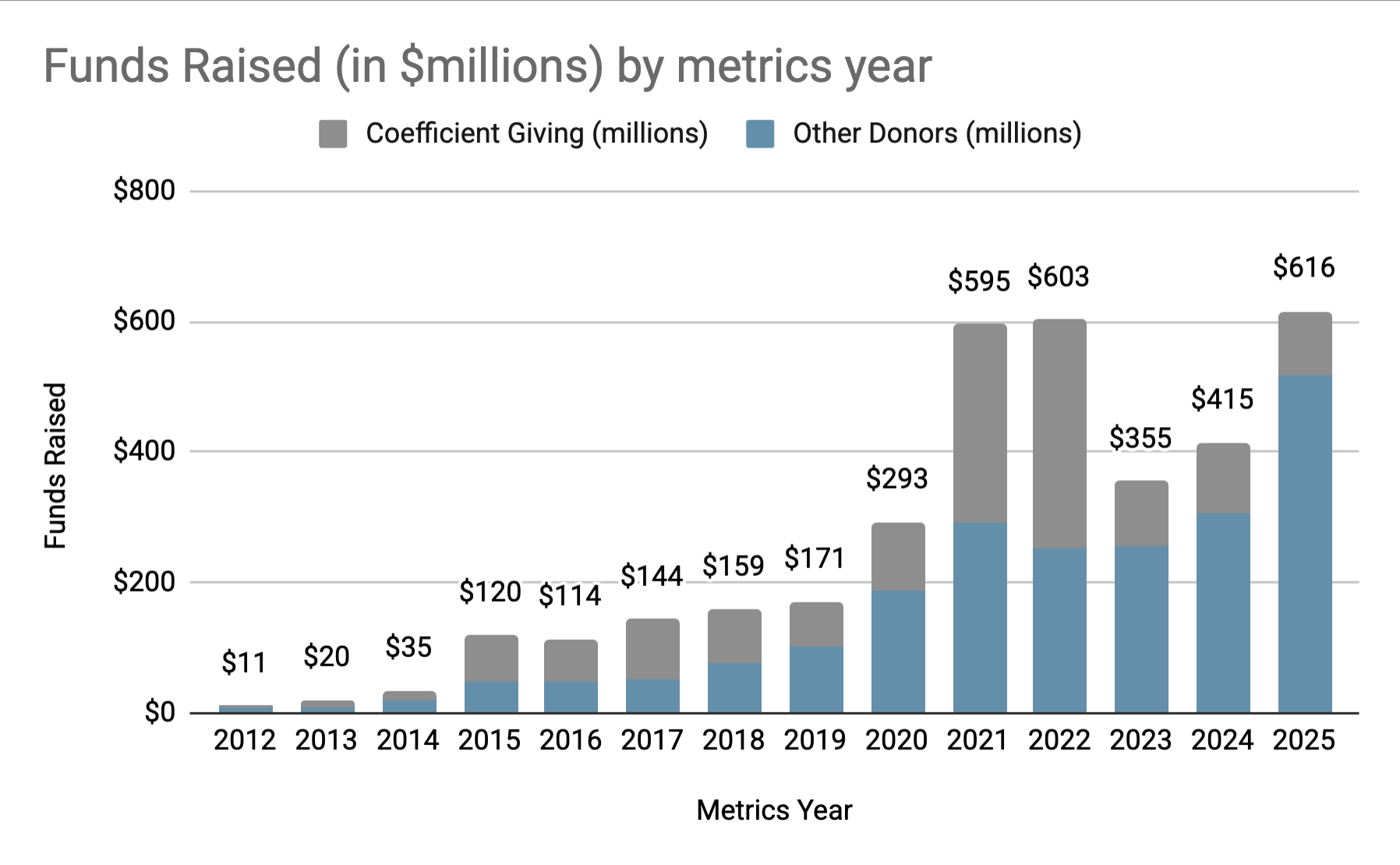
Most donors who give via GiveWell rely on GiveWell to allocate their donation rather than choosing to restrict their donation to a particular organization. Around 95% of funds raised during 2025 fell into this category, which is higher than any previous year.5These funds include donations to the All Grants Fund, donations to the Top Charities Fund, donations to our Unrestricted Fund (which can be allocated to any GiveWell priority, including grantmaking and our own operating expenses), and grants we recommend that other funders make. This category excludes donations to individual Top Charities (either through us or directly to the organization) unless the donation is the result of a specific request we made to a donor.
Funds Directed
In 2025, we directed around $427 million to high-impact programs and organizations. This represents an increase of 8% in funds directed compared to 2024. GiveWell made grants across several areas within global health and development, including grants to incubate newer programs, provide direct delivery of health commodities, promote policy change, fund relevant scoping and research, or support other potentially high-impact, cost-effective initiatives.
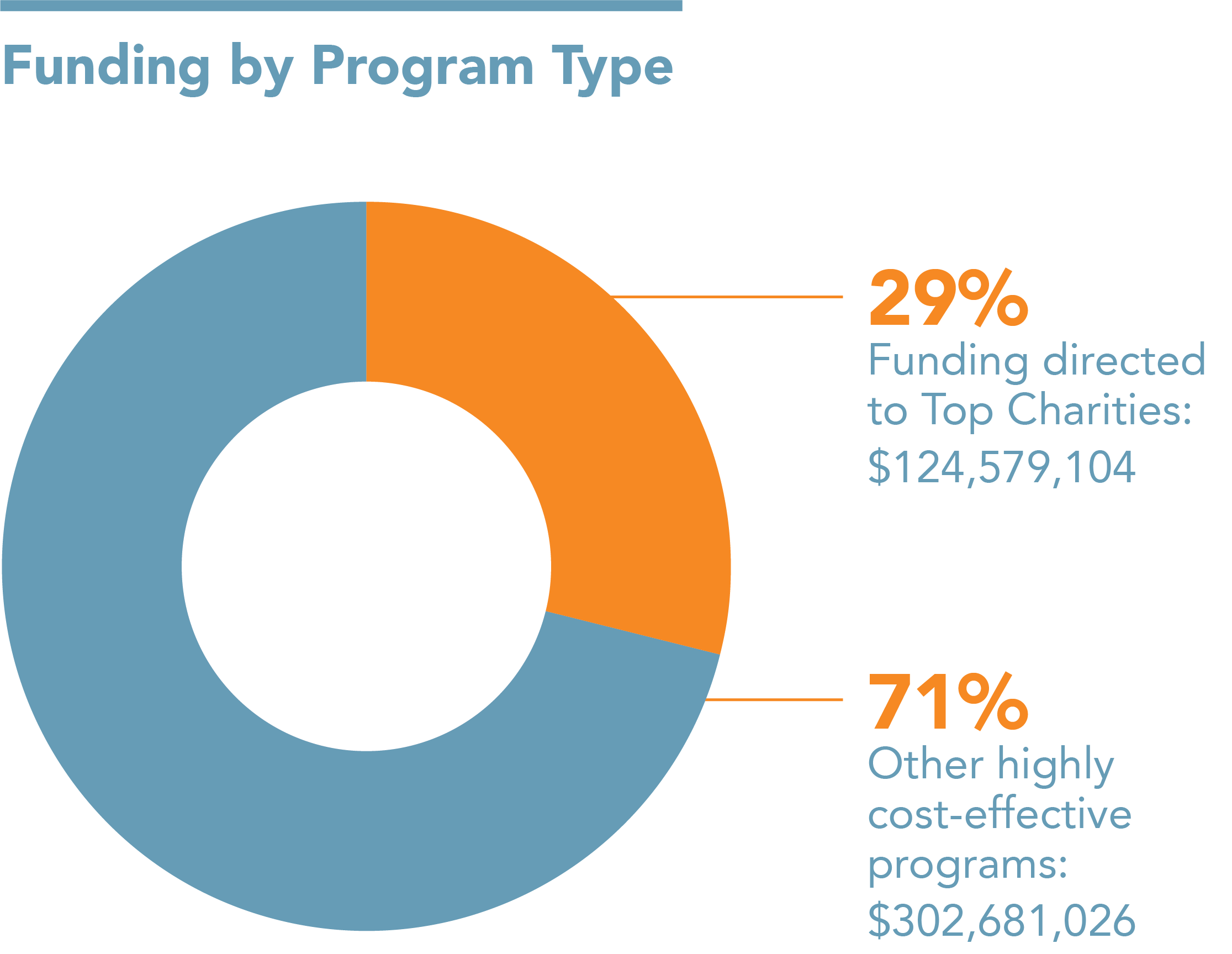
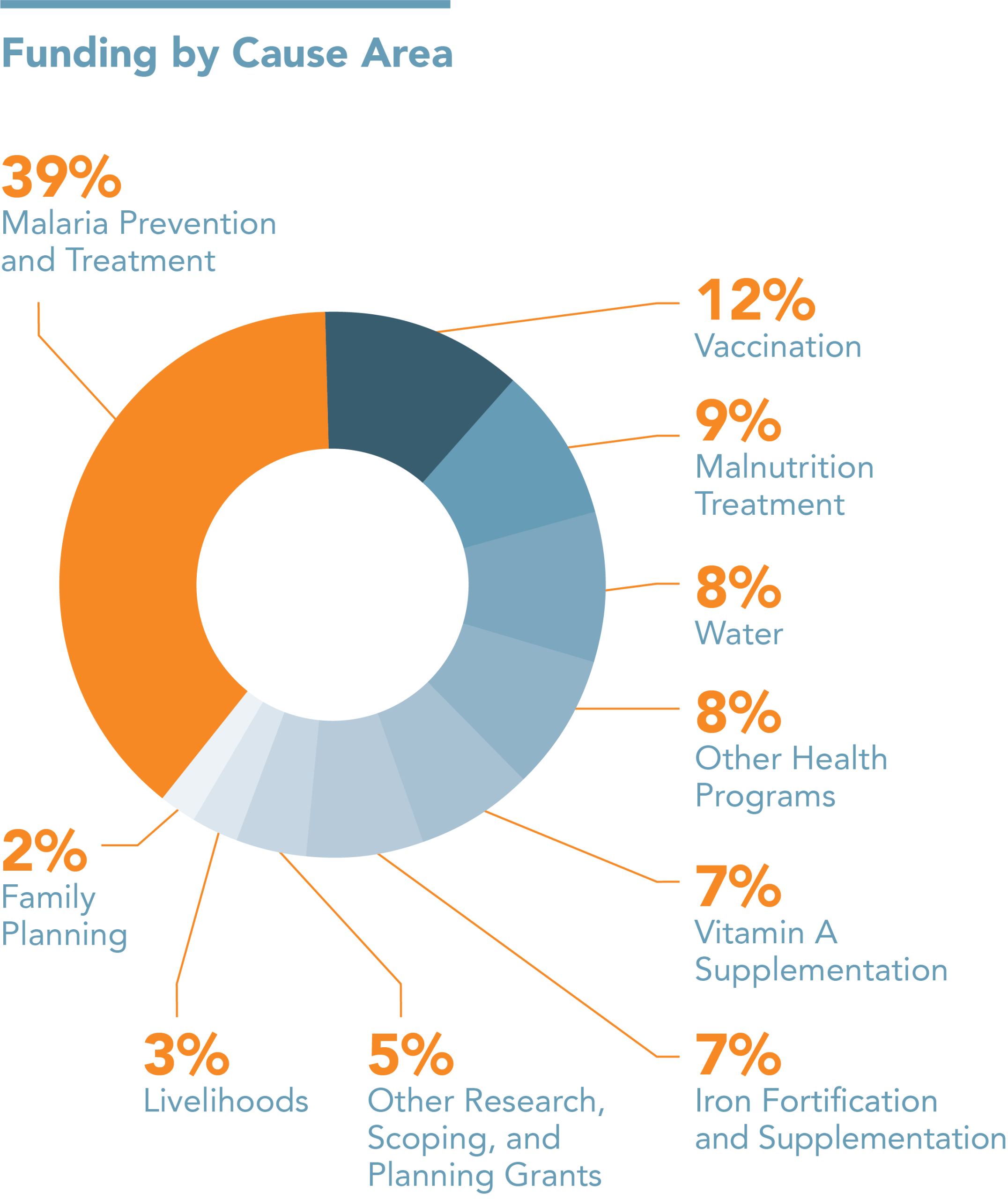
Around $124 million (29% of funds directed) went to our four Top Charities: the Against Malaria Foundation’s insecticide-treated nets via the Against Malaria Foundation, vitamin A supplementation via Helen Keller Intl, seasonal malaria chemoprevention via Malaria Consortium, and conditional cash transfers to increase infant vaccination via New Incentives.
We expanded our research scope in 2025 to help us identify more high-impact opportunities. For example, we:
- Invested in the growth of our new areas research team, which investigates programs and cause areas that GiveWell hasn’t historically focused on.
- Deepened our investigation of livelihoods programs, which increase the economic well-being of people in extreme poverty, by hiring a dedicated program officer.
- Funded initial grants in a newly established family planning portfolio.
Our growing research capacity meant that we could find a broader array of highly impactful programs. Around $303 million (71% of funds directed) went to programs beyond our Top Charities, including malnutrition treatment, iron fortification and supplementation, syphilis screening and treatment, water quality interventions, and much more. We believe this effort to uncover new, cost-effective ways to save and improve lives will enable us to do even more good in future years.

Notes
| ↑1 | GiveWell’s metrics year runs from February 1 through January 31. |
|---|---|
| ↑2 | The countries include Angola, Bangladesh, Benin, Burkina Faso, Cameroon, Chad, Côte d’Ivoire, Democratic Republic of the Congo, Ethiopia, Ghana, Guatemala, Guinea, India, Indonesia, Kenya, Madagascar, Malawi, Mali, Mozambique, Niger, Nigeria, Pakistan, the Philippines, Rwanda, Senegal, Sierra Leone, Somalia, South Sudan, Togo, Uganda, Zambia, and Zimbabwe. Some 2025 grants were not specific to a country. |
| ↑3 | The calculations for the estimate of lives saved cover only the 2025 grants that had reduced mortality as a primary outcome. |
| ↑4 | Our World in Data, “Number of child deaths,” 2024, shows 1.60 million deaths of children under five in low-income countries and 2.73 million in lower-middle-income countries, totaling 4.33 million in 2024. World Bank Group, “Mortality rate, under-5 (per 1,000 live births)” shows a mortality rate for children under five of 40.8 for low- and middle-income countries and a child mortality rate of 5.1 for high-income countries in 2024. If children under five in low- and middle-income countries were to die at the child mortality rate of high-income countries rather than at their current rate, representing the potential effect of high-income country conditions existing across low- and middle-income countries, 87.5% of child deaths in low- and middle-income countries would be averted: 5.1 / 40.8 = 12.5%, or 1 − 0.125 = 87.5% percent averted. |
| ↑5 | These funds include donations to the All Grants Fund, donations to the Top Charities Fund, donations to our Unrestricted Fund (which can be allocated to any GiveWell priority, including grantmaking and our own operating expenses), and grants we recommend that other funders make. This category excludes donations to individual Top Charities (either through us or directly to the organization) unless the donation is the result of a specific request we made to a donor. |
Comments
An impressive demonstration of what evidence-led philanthropy can achieve. Directing $427 million through 128 grants across 32 countries and expecting these investments to save about 86,000 lives shows the value of combining rigorous research with timely action. I was particularly encouraged by GiveWell’s response to the global aid cuts and its expansion into new areas while maintaining a clear focus on cost-effectiveness. Reaching millions of people with malaria prevention, nutrition support, and safe water is remarkable. Congratulations to the GiveWell team, its partners, and more than 35,000 donors for turning generosity into measurable impact.