
 “How does helping people make you feel?” That’s what I’ve been asked, and my answer isn’t familiar from any publications on marketing or fundraising that I know of.
When I was younger, I loved playing video games. Single-player video games, without anyone watching. I didn’t get anything for my virtual accomplishments – not appreciation, or respect, or friendship. I didn’t even get the thrill of being good at something, because I knew that most of my friends were better than I was anyway. I didn’t think I was good at these games; I didn’t think I was building up any skill; in brief, I had no ulterior motives.
I just liked killing bad guys. Well, more than that, I hated not killing bad guys. When Heat Man killed my guy and stood around smugly, I wanted to throw the TV across the room, and I couldn’t stop until he was dead.
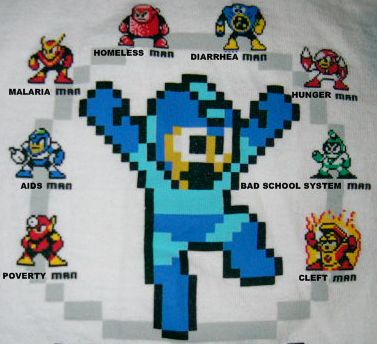
What sucked about this experience was that it was all fake, and in the back of my head I knew that. In the end I felt pretty empty and lame. Enter altruism – where the bad guys are ACTUALLY BAD GUYS. (See illustration.) Sure, I don’t get the same satisfying explosion when they die … I don’t even know to what extent, or whether, they die. So you can think of this video game as being more in the camp of something lame, like an RPG or something. But it’s infinitely better because it’s real. I don’t care whether the kids are cute, or whether the organizations are nice to me, or whether my friends like my decisions. As with video games, I probably spend 99% of my time frustrated rather than happy. But … Malaria Man just pisses me off. It’s that simple.
I’d call my attitude toward giving straight-up altruism. I’ve heard people deny that real altruism can possibly exist, but I don’t think any of them would challenge my description of playing Mega Man, even once I specify that it was the desired outcome, not the feelings, that kept me playing.
There are a couple key differences between my attitude and the motives I commonly hear ascribed to donors. One is the fact that I’m obsessed, and therefore I’m not looking for a pleasant minute-to-minute experience. Charities focus on making giving a pleasant, immediately rewarding experience for the donor, sometimes at the cost of being really truthful and helping the donor to understand; this is because they expect their donor to spend a few minutes, or hours at most. (And that’s all they’ll spend as long as there’s no clear outlet for using their brain as well as their checkbook.) Another key difference is that I’m not looking to feel validated or important or un-guilty or generally “good” in any warm and fuzzy way; I’m looking to actually kill the bad guy, not just prove to myself that I tried. No matter how it makes me feel, a charity is failing me if it doesn’t get results.
Comments
If I understand your analogy correctly, you’re saying God (Dr. Light) created Malaria and Diarrhea and Aids (respectively, Quick Man, Air Man, and Flash Man) for specific purposes (like killing monkeys, or bad people) but then they went awry and he lost control of them and they starting killing kids.
Am I in the ballpark?
In all seriousness though, it sounds like the motivation behind your charity work is not so much that you enjoy giving, but more that you enjoy the idea of your giving. You like playing the role—you did, after all, compare it to an RPG—of an altruist.
But maybe I’m missing the point, and that the reason it’s not an RPG is that you’re dealing with real-life villains.
The reason I liked video games was because I liked PRETENDING to kill bad guys. But I wouldn’t like pretending to do it if I didn’t like ACTUALLY doing it 10,000x as much.
Is there a possibility that by abstracting these scourges—turning them into “bad guys” and making it a personal challenge to beat them—you’re dissociating them from the people they affect? Doesn’t charity then become about you?
Do you think your approach can work on a wide scale? Is it even your goal to change people’s motivations for giving?
Our goal is to serve people who want to help people effectively, no matter what their ultimate motives. I’m merely pointing out that my motives are particularly conducive to being results- rather than feelings-oriented, and I believe that people who think like me (or prioritize results for any other reason) are underserved by the current landscape of fundraising.
Everything comes down to helping people … “I want to help people in the same way I want to kill Heat Man” would be a more accurate, but less clean, metaphor than “I want to kill Malaria Man.” If it helps, think of saving the Princess in Super Mario Bros., or cleaning up the villages in ActRaiser.
Is Dr. Robotnik himself a robot?
Hi, im a serious gamer and i think video games are way better than charity work. Then again i get payed to play video game 😛
You know I never really thought about this before but perhaps playing videogames does instill some ideas of altruism in us? I played a ton of video games (ha I still do) and I get where you’r ecoming from with this, I have some similar feelings. I mean the’re basically stories, with conflict and resolution. Stories reinforce the idea that if we work towards good, good will be created eventually.
The whole point of video games though is to escape reality. Sure the world might be better off if everyone spent the time playing video games instead working for a charity, but that just isn’t realistic. People need time to unwind and just shot bad guys occasionally. What is interesting though is the next generation of video games that would allow players to play a fun game, but at the same time use that information from the game to cure a disease solve a problem etc. The DNA untwisting game recently featured on digg comes to mind.
Server, what digg post are you talking about? I searched for “DNA game”, “DNA untwisting”, “DNA”, and came up empty handed.
When I was young, I also played video games (Counter Strike) with my friends. We killed bed guys together and it was fantastic =)
Asteroids ring a bell? Not too many years earlier, it was Pong . . . man I feel jurrasic!
That is a very strange but interesting way to look at things. Whatever works for you is great. Charity is something that should be a part of everyone’s life.
Mega man was the best video game as a kid, I too got extremely pissed when I got killed by “malaria man” lol, thsi is a good way to look at things though, I enjoyed reading this post. God Bless to those who give 🙂
Aaah ,yes,Mega Man so many fond memories when I played for hours killing the bosses and acquiring their abilties , I think I collected most in the Mega Man series and nearly completed all of them.
And your right some video games do seem to be apt metaphors in real life.
I used to play games for hours a week. I liked feeling like a hero. Then I realized if I were on my deathbed what would I say? Oh I wish I had played more video games. I don’t thinks so. I will play with friends now but I will not play alone anymore.
Thanks for a great post
One of the things that people like about video games and other games is the opportunity to take on a challenge in a safe (safe enough, by the player’s standards) environment.
This is also, to some extent, the reason that people try to defeat cancer, malaria, and malnutrition: They want a challenge, and they want to FEEL like they’ve accomplished something. My preference would be to have people seek to FEEL like they’ve accomplished something and ACTUALLY accomplish something at the same time. Video games are kind of like the very worst non-profit organizations in that you can feel like you’re accomplishing something without actually accomplishing anything.
Comments are closed.