The GiveWell Blog

Giving season update

We’re about halfway through December, which is historically when the vast majority of donations go through our website. Here’s a quick update on where things stand.

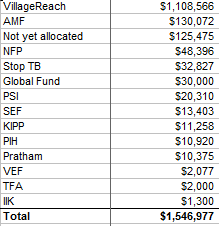
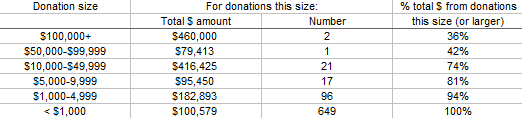
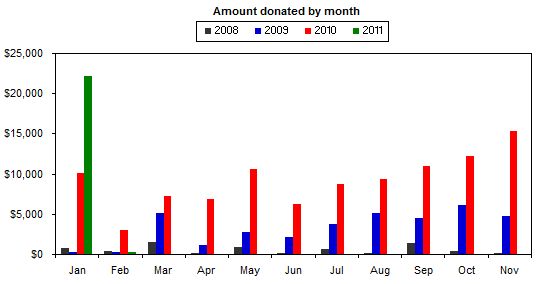
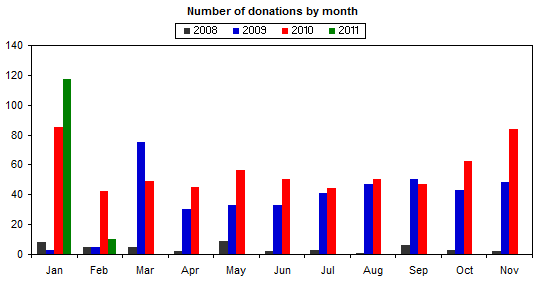
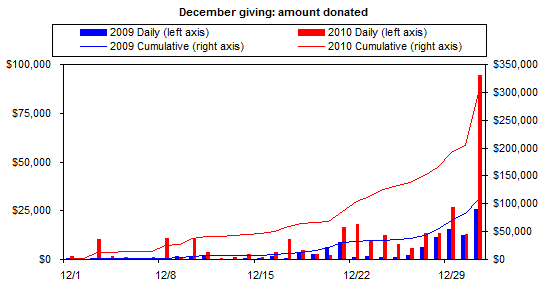
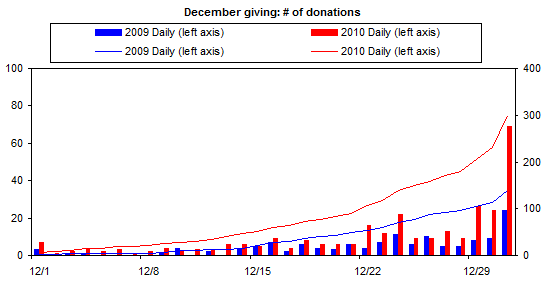
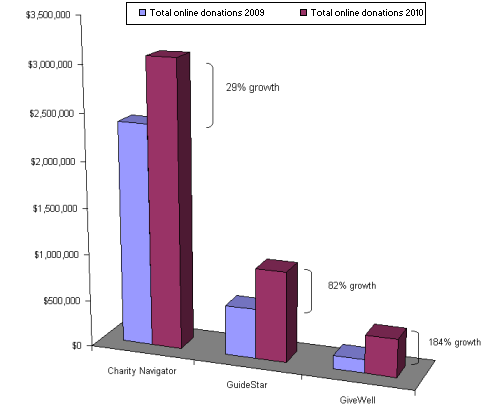
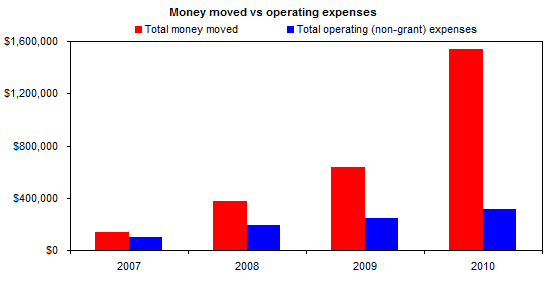
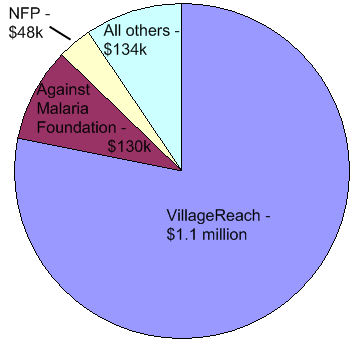
So far this year, we’ve seen significantly more money (over 3x as much) go to our recommended charities, directly through the GiveWell website, compared to last year.


The second chart above excludes December, as this month has generally completely dwarfed the others in terms of donations made through our website. The following chart shows daily donations made in December, during which the trend has continued.

Note that all charts above exclude all offline donations / donations made through other sites attributed to GiveWell; they are only capturing donations that were made directly via the GiveWell website. We’ll be giving a full overview of our estimated “money moved” when we release our annual self-evaluation in a few months.

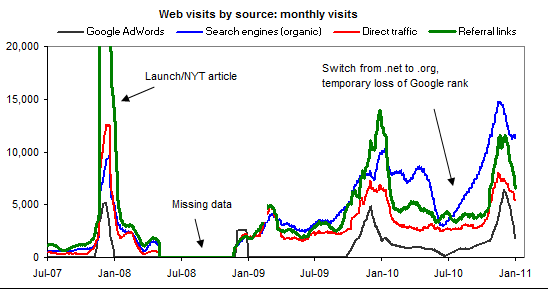
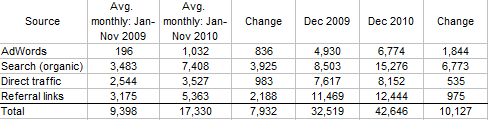
Our web traffic is also up this year, driven primarily by an increase in organic (i.e., non-AdWords) search traffic.

We’re seeing strong growth that isn’t attributable to any particular one-off event, so we’re optimistic about future growth.

The best charity that no one has heard of: How would you tell its story?

We’ve spent years looking for the most outstanding organizations we can find – organizations with demonstrable, cost-effective, powerful impacts on people’s lives. As of now, out of hundreds examined with a systematic process, we’ve found one that we think is particularly outstanding. It isn’t just outstanding by our criteria – it’s also strong on a lot of the aspects we purposefully de-emphasize but others value, such as the chance to make a large-scale and sustainable contribution well beyond its budget (more). There’s only one problem: it’s in the sector of health system logistics.

It’s been observed before that fundraising seems to work best when you can connect a person’s gift to a tangible, emotional impact. Heifer International can tell you about the “cow you’re giving for Christmas” and how it (ideally) will affect its recipient’s life. Grameen Foundation has anecdotes (example) of women who’ve used a loan as a catalyst to pull themselves out of poverty. DonorsChoose can even arrange for you to get thank-you notes from the students you’ve bought supplies for.

VillageReach’s activities include

  • Training health system personnel to become logistics specialists, delivering medical supplies to all the hard-to-reach villages so that health workers working in remote health centers are no longer responsible for making the long journeys to collect their own supplies.
  • Developing logistics management information system software to enable more accurate collection and reporting of health data in remote communities.
  • Creating a social business to bring propane from south Mozambique to north Mozambique so that refrigerators in health centers can be more reliably powered, and can keep vaccines cold.

How do you tell that story?

One possible response is “Don’t.” In a world full of good causes, why worry about delivery systems, information management and propane in Mozambique, when we can focus on charities with more tangible, “sellable” work?

Yet we feel this response would be tantamount to defeat for the “smart giving” movement. VillageReach embodies the strengths this movement looks for – strengths that are all too hard to find most of the time. After all, if you’re bringing in tens of millions using a decades-old story, why bother with evaluation and accountability for the work happening today? What good is real impact if it isn’t rewarded with funding?

We want to see VillageReach turn its great program into a great pitch, but we’re no good at storytelling. So we’re asking for help.

If you are good at helping charities tell their stories, and you support the ideals of the “smart giving” movement, we’d like your thoughts on how VillageReach can better sell its work.

Give your advice via blog post, or blog comment, or email to us. If you make your own blog post, please make sure to notify us via email or by linking to your post in a comment here.

We’ll round up the best submissions in a future post.

Some basic materials to work off of:

Thanks to Katya Andresen for inspiring the title of this post

Joint release on finding the best charities, not just avoiding the worst

Last year, we and many other groups came together in a joint press release on the “worst way to pick a charity.”. We argued that the simple, “one-size-fits-all” metric of the overhead ratio is a red herring, and that deeper analysis is needed to make sure your gift accomplishes good.

But many donors don’t have time for deeper – or any – analysis. To help them, this year three organizations – GiveWell, Philanthropedia and Root Cause – have come together with a list of 6 recommended charities.

Each of our organizations has recommended two charities, using our distinctive methodologies. Note that we haven’t vetted each others’ recommendations and do not necessarily endorse each others’ endorsements – but we think it’s important to show donors (even donors with very little time) what sorts of options they have, publicly and centrally.

As our release states, and as we’ve written before many times in the past (most recent discussion here), we think that there is currently far too much emphasis on avoiding bad charities, with the implication being that it’s fine to give to whatever charity asks most loudly once you’ve determined that they aren’t literally stealing your money. We want to change the subject from “How can donors avoid the very worst charities?” to “How can they seek out the very best?” This joint list of recommended charities is a step in that direction.

Full release – including the six charity recommendations – here

New content: New research report, new ratings system, DIY Guide, and self-evaluation

We’ve been working on a lot of changes and additions to the main GiveWell website and at this point have gone live with all of the following:

New research and recommendations on U.S. education and early childhood care. We did some work on these causes in our first year, but we’ve now gone back with our improved and more thorough research methodology.

Do-It-Yourself Charity Evaluation. If you’re looking to do your own due diligence, examining a charity or cause we haven’t covered, check out our DIY guide for suggested critical questions you can ask. We’ve covered every charitable cause we can find or think of.

This is the first donor guide we’re aware of that asks different questions for charities in different causes, rather than taking a “one-size-fits-all” approach. While it means some extra overhead in classifying your charity, it also means we’ve been able to make the questions much more concrete, specific and meaningful.

This is very much “beta” content, with room for improvement in the questions themselves and in the guide’s usability, and we are very interested in your feedback. (Note that Tactical Philanthropy and Chronicle of Philanthropy Online have already discussed this new feature.)

New ratings system. We wrote back in October that we were preparing to scrap out quantitative ratings system for charities. We have now done so. We still give marks of distinction to our top-rated charities, and we still discuss the charities that don’t get these marks of distinction, but we no longer have a “zero-to-three-star rating” for each charity. See the new details of our ratings system.

Charity downgrades. We’ve completed our annual review of our recommended charities, in which we request updated performance information, sometimes request more detailed information than we did in the first place, and rethink our evaluation in general. Three of these charities have received downgrades:

Part of what’s going on here is a gradual raising of our bar, as we have capacity for more analysis and a substantially higher opinion of our top-rated charity VillageReach than we had last year. (In addition to a site visit that involved a lot of time spent discussing and improving our understanding of the organization, we also have updated, concrete, encouraging information on the group’s expansion plans / room for more funding.)

New external evaluations of GiveWell’s work. We have begun accumulating formal reviews of our research from non-staff members; some are scholars in relevant fields while others are simply willing volunteers. We have published the reviews we have so far and intend to add more at a faster pace from here, now that we’ve nailed down the basic ground rules of how to do external reviews of different parts of our work. Note that we have also begun collecting endorsements as a quick sign of our credibility for website visitors.

What’s next: within the next few months we will be publishing

  • Extensive notes from our several months in India, including site visits to over 15 organizations.
  • Research and recommendations on the general cause of disaster relief/reconstruction.
  • Our annual self-evaluation.

After “extraordinary and unorthodox” comes the valley of death

An anonymous donor got some buzz a few weeks ago with its call on Innocentive for “extraordinary and unorthodox” philanthropic opportunities. It seeks a project that “holds the potential for a transformational impact,” “is unlikely to attract funding elsewhere due to its risky, unorthodox, and/or neglected profile,” and will be able to “attract additional capital from other sources” after the initial “catalytic” funding.

Perhaps ironically, this RFP sounded very familiar to me. In fact, it’s hard for me to see a big difference between it and the $100 million Gates Grand Challenges Explorations, “a unique initiative that supports innovative research of unorthodox ideas” in global health (though the Innocentive proposal above does not explicitly specify a sector, all three of its examples are in global health as well).

Speaking more informally, I’ve heard similar concepts emphasized by most major funders I’ve spoken with. Anyone who has dealt with major foundations should recognize the desire to find a completely new, revolutionary, neglected opportunity that just needs some seed funding to explode.

I do believe that the best opportunities are the under-funded ones. Yet I’m not sure that tiny, neglected innovations are the best places to look for these opportunities – precisely because that’s where all the major funders seem to be looking. I submit that the better place to look for neglected opportunities is the “valley of death” between proof of concept and large-scale rollout.

“Valley of death” is a term from both the investment and research communities. In both cases, broadly speaking, it refers to the difficulty of getting funding between the earliest stages of a project and the latest stages of a project, where investors have neither a sure thing nor a “lottery ticket” for the glory of being “first.”

I believe that the world of philanthropy suffers from its own “valley of death.”

Programs that have enough traction often aim for funding by the government (for example, the Nurse-Family Partnership program has had some success with this). Programs in their earliest stages appeal to foundations’ hunger for bragging rights. But what about VillageReach, which had a single successful “proof of concept” pilot project (initially funded by the Gates and Skoll foundations and the World Bank Development Award) and now needs transitional funding to roll out its model across Mozambique? Large foundations have, to date, declined to fund the rollout, in some cases specifically citing their preference for establishing models rather than rolling them out.

There’s no glory in funding the VillageReach rollout. VillageReach already has shown that what it’s doing has worked; nobody can claim to be brilliant for spotting it. And VillageReach doesn’t need help designing its program (this has been cited to me explicitly as a drawback from the perspective of some major funders).

But if it doesn’t get funded, it isn’t going to happen. If it does, it could change the world. It is, in fact, a fantastic opportunity.

If you asked me which funders are going to have the greatest impact over the next decade or so, I’d bet on the funders extraordinary and unorthodox enough to forget about being “extraordinary and unorthodox” – and instead put in a bid for the Smart Money Award.

Health system strengthening + sustainability + accountability

We’ve written a lot about our top-rated charity, VillageReach (in particular, see our official review and our 2009 blog post). Consistent with our focus on individual/casual donors, we generally emphasize effectiveness over ambition, and so we have mostly focused on VillageReach’s fit with our criteria: its strong case for effectveness, cost-effectiveness, and room for more funding.

However, VillageReach has some other major strengths as well – strengths that make it a good fit not just for individual donors looking to help people cost-effectively, but also for more ambitious donors hoping to contribute to transformative change.

Health system strengthening – with tangible results

One of the ongoing debates/discussions over health aid involves “vertical” vs. “horizontal” interventions. I recommend William Easterly’s Can The West Save Africa? (start on page 57) for an overview of the issue, but briefly:

  • “Vertical” programs focus on global large-scale campaigns addressing a particular health condition, often focusing on the supply of appropriate medical materials (for example, vaccines and antiretroviral drugs for treating HIV/AIDS) while “horizontal” aid tries to strengthen the health system in general in a particular region.
  • “Vertical” programs have had some major demonstrable successes (for example, most of the cases in Millions Saved). However, many believe that once the major opportunities have been capitalized on, these sorts of initiatives hit diminishing returns, as medical supplies outstrip the health system’s ability to deliver them. Over-funding a particular campaign may even get in the way and undermine other health efforts.
  • “Horizontal” programs have the worthy goal of making the health system stronger as a whole, including reaching those who are hardest to reach. However, perhaps because these programs often involve more complex goals and more leeway for the funded, these programs do not have the same track record of demonstrable success, and arguably have inferior mechanisms for accountability (i.e., making sure that money is spent well and produces actual results). See this Aid Watch post for more on these problems.

VillageReach’s program, focused on health system logistics, is fundamentally more “horizontal” than “vertical” – it’s focused on improving health system capacity. For example, one of the major changes its pilot project brought about was creating a specialized team for delivery of vaccines, which relieved local health system personnel of the responsibility to collect their own vaccines. The aim was not only to get supplies out to the villages in a more reliable way, but to reduce demands and constraints on the many local health system personnel. In the future it may expand this model to other health supplies. It’s not just using donations to purchase supplies – it’s reorganizing the system to improve overall efficiency and even reduce total costs.

Yet unlike many “health system strengthening” initiatives, VillageReach’s program holds itself accountable with specific deliverables, promising – for example – a drastic drop in the frequency with which health centers run out of vaccines. It has run surveys of vaccination rates, comparing the province it worked in to a nearby province. Looking at vaccination rates cannot capture all of the benefits VillageReach aims to provide, but it provides a strong reality check on the model and suggestive evidence for whether it is indeed improving efficiency.

The program thus addresses one of the thornier, and difficult-to-evaluate, areas of global health, while maintaining strong accountability and demonstrable results.

Ambitions of transformation and sustainability – with tangible results in the meantime

Two other constant tensions we perceive in health initiatives are between (a) short- and long-term impact; (b) tangible and transformative impact. In neither case are the two goals clearly contradictory, yet in practice there often seem to be tradeoffs.

For our part, we have focused on short-term, tangible impact. As we lay out in our process overview, we are focused on serving individual/casual donors, and we feel these donors should look first and foremost for accountability and results. A chance at “hitting the jackpot” (creating a permanent and/or far-reaching change) ought to be considered a bonus, not a requirement, especially when the short-term tangible impacts are as good as saving a life for every $1,000 (or less) spent.

Yet the best charity we’ve found for these short-term, tangible impacts turns out to be very ambitious, with very high upside should they succeed. As detailed in our review, VillageReach isn’t just implementing a new health system – it’s advocating for this system as a new approach to health logistics all across the country of Mozambique. It has produced cost analysis concluding that the government will save money, long-term, by adopting its model; with this analysis and its superior results in hand, it has won the endorsement of the national Ministry of Health. It appears to have as good a chance at a lasting impact on how the government operates as any other charity we’ve seen.

Its impact need not even end within Mozambique. Getting supplies to hard-to-reach areas is a challenge that applies throughout the world of global health (and indeed VillageReach has been retained as a contractor in Senegal, Malawi and India).

If you’re hoping your donation has a chance to be a part of a new innovation with global impact, VillageReach gives you that chance. Of course, many other charities have equal or grander ambitions. The difference is that VillageReach is (from what we’ve seen) holding itself far more accountable, producing tangible – and cost-effective – impact as it goes.

What’s not to like?

Our process has been accused of over-focusing on tangible impact and evaluation, and thus favoring larger, more conservative organizations. This accusation has some truth to it (and we accept this bias in view of what kind of donor we’re serving). And yet, the organization we’ve found that performs best on our criteria is in fact relatively small, and highly innovative. Indeed, of all the organizations out there with big ambitions, we believe VillageReach – with its high accountability and its focus on producing results, not just hopes, in the meantime – to be the best bet to actually deliver.