The GiveWell Blog

Microfinance and cookstoves

Two interventions that command a lot of attention are microfinance (financial services, particularly small loans, for the very poor) and improved cookstoves (with the hope of reducing air pollution). We’ve recently seen a couple of helpful summaries of relevant research:

  • David Roodman summarizes the most rigorous research on microfinance. There are now five randomized controlled trials on microlending that have at least published some preliminary results; it looks like there is very little in the way of direct poverty reduction or wellbeing improvements, though there is positive impact on “stimulating enterprise.”
  • Charles Kenny discusses a recent study that randomized heavy subsidies of cookstoves in India, and found that “Households failed to use the stoves regularly or appropriately, did not make the necessary investments to maintain them properly, and use ultimately declined further over time,” leading to no significant positive impact. According to Mr. Kenny, this result is consistent with previous literature on the matter. On the other hand, Aid Thoughts points to another study in Senegal reporting, after one year, that “households receiving an improved cooking stove used less wood, spent less time cooking meals, reported better indoor air quality and (for women, who presumably did all the cooking) were significantly less likely to have respiratory disease symptoms, eye problems. Nearly all recipients of a stove used it at least seven times a week.” We note that the latter study discusses only one-year effects, while the India study found “a meaningful reduction in smoke inhalation in the first year [but] no effect over longer time horizons.” Note that we haven’t carefully examined these papers and that cookstoves are not a focus of ours, but since the recent studies are both fairly rigorous we thought it was worth noting them and their conflicting results for interested readers.

Update on the Schistosomiasis Control Initiative: Our current #2-ranked charity

Since GiveWell recommended the Schistosomiasis Control Initiative (SCI) in November 2011, SCI has received about $1.4 million in unrestricted funds ($500,000 of which we directly attribute to GiveWell’s recommendation), of which $1.1 million remains to be spent. We have spoken with and met with SCI to discuss its plans for using these funds.

Funds spent to date

  • SCI has made grants of $100,000 and $80,000 to Yemen and Senegal respectively for deworming drug delivery.
  • SCI has granted about $25,000 to Tanzania to treat 153,000 children in one region.
  • As part of discussions with the government about starting a national deworming program, SCI spent approximately $13,000 to support a conference on the deworming in Ethiopia.
  • SCI has spent about $99,000 of the unrestricted funding on various organizational expenses such as travel and one staff member’s salary.

Plans for funds raised due to GiveWell’s research

SCI is currently planning to fund the delivery of donated schistosomiasis drugs to 1.5 million children in two regions of Ethiopia, and support disease mapping in other parts of the country. SCI is currently waiting on a budget from Ethiopia, but we estimate this project will cost a few hundred thousand dollars. SCI has told us that it expects these treatments to be delivered by the end of 2012.

SCI has also committed $100,000 to fund treatment of adults in one district of Burundi.

SCI is exploring the possibility of supporting deworming programs in Zimbabwe and the Democratic Republic of Congo. In addition, it may use unrestricted funding to provide additional treatments in Tanzania and Malawi, which are primarily supported by a large grant from the British government.

Comparing current plans to past plans

In November 2011, SCI told us that it would primarily use additional funds to expand deworming programs in Mozambique, Malawi, and Senegal. Recently, SCI told us that these are no longer the countries it expects to focus on with the funds raised through GiveWell. What has changed:

  • SCI told us that it raised sufficient funding from other sources to support the Senegal program and that it never intended to expand the program beyond paying for delivery of drugs that were already available from the World Health Organization. We had been under the impression that SCI would expand this program further if it raised the money to do so, but it appears that we had a miscommunication with SCI on this point.
  • In 2010, SCI received funding from the British government to support deworming programs in 8 countries, including Mozambique and Malawi. SCI recently decided that programs planned for two of the countries weren’t feasible, and shifted the money it expected to spend in these two countries to the Mozambique program.
  • There may be other changes that we are not including here. We are not confident in our understanding of why SCI changed its plans.

Comments on SCI’s plans

First, SCI expects to spend almost all of the funds it has received due to GiveWell’s recommendation for a single round of treatment (save 15% of the funds, which it will hold for future treatments). Because multiple deworming treatments appear necessary for long-term impact (though the evidence on how many treatments are needed is thin), we are concerned that spending nearly all the funds now, could reduce SCI’s expected impact.

Second, our position is that treating children accounts for the majority of impacts from deworming. We are not confident in the impact of treating adults in Burundi.

How not to be a “white in shining armor”

Edited April 2024 to fix several broken links.

This post inspired by the upcoming Day Without Dignity online event

GiveWell’s current top-rated charities focus on proven, cost-effective health interventions. These interventions appear to solve certain problems (malaria, parasites) quite well, while making no direct attempt to solve other problems (economic growth, education, gender equity, and more). One of the common lines of objection we get to these recommendations goes something like: “Why should I put all my money into fighting malaria, ignoring other important problems? Isn’t it unethical to ignore the other essential needs?”

We believe this objection commits the common fallacy of viewing the developed-world donor as the only person who can improve things for the beneficiaries. One term for taking this mentality too far is “Whites in Shining Armor” – often, in the media and in nonprofits’ communications, global poverty is presented as a simple fight between local problems and developed-world heroes. The problem is that as outsiders, we often have very poor understanding of the true dynamics behind overseas problems – and by attempting to solve problems that we understand poorly, we can make things worse.

We fundamentally believe that progress on most problems must be locally driven. So we seek to improve people’s abilities to make progress on their own, rather than taking personal responsibility for each of their challenges. How can we best accomplish this?

Locally driven projects
A common and intuitively appealing answer is letting locals drive philanthropic projects. This answer has some appeal for us; we have written before about, and given a small amount of money to, “low-insulation charities” that seem adaptive, locally connected, and overall driven by local needs rather than donors’ plans. At the same time, we have noted some major challenges of doing things this way. Which locals should be put in charge? There are inherent risks that the people who least need help will be best positioned to get involved with making the key decisions. In our reflections on our visit to India, we noted that some organizations seemed to consist simply of local elites making ad-hoc decisions, and that to truly reach those who most need help seemed to require being “systematically bottom-up,” a more complex and difficult approach.

Global health and nutrition
Another approach to “putting locals in the driver’s seat” is quite different. It comes down to acknowledging that as funders, we will always be outsiders, so we should focus on helping with what we’re good at helping with and leave the rest up to locals.

Here I think an analogy to helping friends and family is somewhat illustrative. I try to help my friends and family in domains that I’m relatively knowledgeable about (for example, computer issues) and I tend not to put much effort into helping in other areas I’m not so knowledgeable about (for example, picking clothes) even if the latter are more important issues for them. I know I appreciate when my friends and family deal with me this way, and I don’t appreciate people who are determined to help me in domains that they don’t understand very well (even if these domains are very important to me).

We believe that the track record of outside aid points to health and nutrition as the areas that developed-world outsiders understand best and are best-positioned to help with.

It’s not that we think global health and nutrition are the only important, or even the most important, problems in the developing world. It’s that we’re trying to focus on what we can do well, and thus maximally empower people to make locally-driven progress on other fronts.

Cash transfers
One more approach to “putting locals in the driver’s seat”: give to GiveDirectly to support unconditional cash transfers. We feel that global health and nutrition interventions are superior because they reach so many more people (per dollar), but for those who are even more concerned than we are about the trap of “whites in shining armor,” this option has some promise.

Update on GiveWell’s web traffic / money moved: Q1 2012

In addition to evaluations of other charities, GiveWell publishes substantial evaluation on itself, from the quality of its research to its impact on donations. We publish quarterly updates regarding two key metrics: (a) donations to top charities and (b) web traffic.

The charts below present basic information about our growth in money moved and web traffic thus far in 2012.

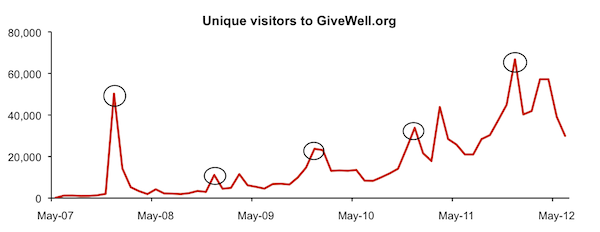
Website traffic tends to peak in December of each year (circled in the chart below). Growth in web traffic has remained strong.

Growth in money moved has remained strong as well. The majority of the funds GiveWell moves comes from a relatively small number donors giving larger gifts. These larger donors tend to give in December, and we have found that growth in donations from smaller donors throughout the year tends to provide a reasonable estimate of the growth from the larger donors by the end of the year.

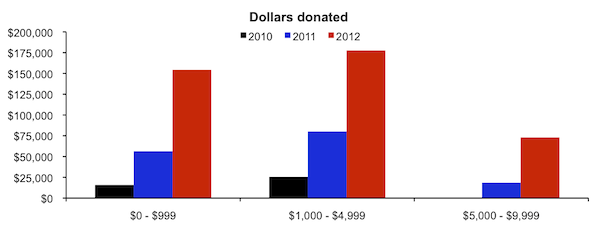
Below, we show two charts illustrating growth among smaller donors.

Thus far in 2012, GiveWell has directed $228,351 to our top charities from donors giving less than $10,000. This is approximately 3x the amount we had directed at this point last year.

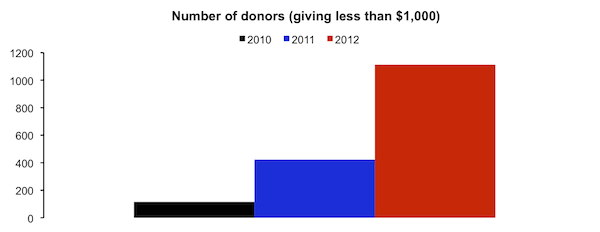
Most donors give less than $1,000; the chart below shows the growth in the number of smaller donors giving to our top charities.

Overall, 760 donors have given to GiveWell’s top charities this year (compared to 274 donors at this point last year).

In total, GiveWell donors have directed $631,879 to our top charities this year, compared with $456,567 at this point in 2011. For the reason described above, we don’t find this number to be particularly meaningful at this time of year. One major difference between 2011 and 2012 is that in 2011, Ken Jennings allocated the $150,000 he won participating in a Jeopardy! contest against IBM’s Watson to VillageReach.

VillageReach update

Context: VillageReach focuses on health-system logistics in the developing-world. It was our top-rated charity from July 2009-November 2011, and GiveWell donors contributed over $2 million to it. These funds have primarily been directed towards a scale-up of VillageReach’s approach to health supplies in Mozambique. We have been posting regular updates on VillageReach’s progress.

In addition to a summary of our update (below), we have also published:

  1. A full, detailed update on VillageReach’s progress
  2. A guest post from John Beale, VillageReach’s Director of Strategic Development and Group Lead, Social Business.


We’ve just published an update on VillageReach’s progress. This post provides highlights from that update. In brief, progress has been discouraging on multiple fronts; VillageReach has made significant changes to its project plan and budget as a result; its resulting cost-effectiveness is likely to be substantially less strong than originally anticipated. All of these observations are made possible by VillageReach’s continuing transparency and commitment to collecting meaningful data. We always prefer discouraging observations to no observations.

VillageReach’s scale-up of its pilot project has hit multiple setbacks:

  • Obstacles getting the program running. The program has run into significant obstacles in the two provinces in which VillageReach has been operating since late-2010/early-2011. The primary problem has been accessing funds from non-VillageReach sources to pay the health workers who implement the program. Lack of funding for these workers led them to stop implementing the program and no vaccine deliveries were made in either province for several months in the mid-to-late 2011. Work in two additional provinces has begun but is now significantly behind schedule. VillageReach has decided, going forward, to step in and provide funding itself when necessary; it reports that in the four months following this change, distributions occurred to all health centers on time.
  • Increased expected costs. Actual costs have been higher than expected and VillageReach now projects roughly twice the costs it initially did. This is a primarily a function of (a) actual costs exceeding expectations and (b) increased expected costs due to VillageReach’s deciding to fill gaps, when necessary, left by other funders to ensure the project runs smoothly.
  • Scaled-back future plans. Because of these problems, VillageReach has significantly scaled back its plans for the project, intending for the time being to work in 4 provinces rather than 8.

We now believe that VillageReach has room for more funding of approximately $1.5 million for 2012. This represents a change from our October 2011 statement that VillageReach did not have short-term room for more funding; the change is primarily due to the passage of time and some changes in the timing of expected expenditures rather than to any major change in VillageReach’s total projected costs.

We have not yet determined where VillageReach should rank on our top charities list. Its commitment to transparency and meaningful data collection – which have allowed the discouraging observations above – are major points in its favor, in our view, and we will likely attempt to ensure that it continues to have enough funding (something we believe we have ample time to do at the moment).

We are also more deeply examining the original evidence of effectiveness for VillageReach’s pilot project. Our standards for evidence continue to rise, and our re-examination has raised significant questions that we intend to pursue in the coming months. The deeper examination comes about because:

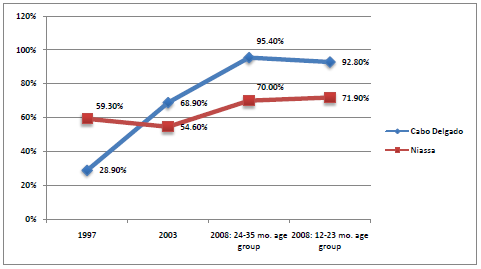
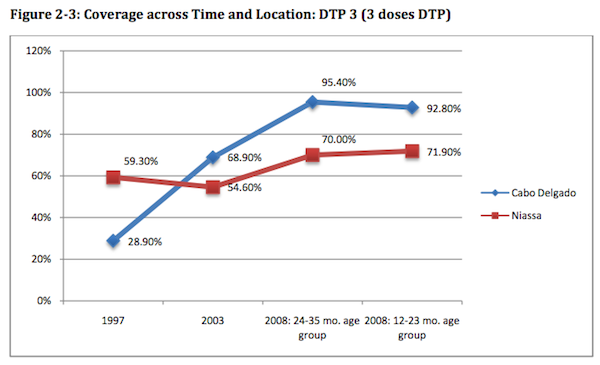
  • Our research process has changed. In 2009 and 2010, VillageReach’s impact assessment was the best we had ever seen from a charity. Our research process has evolved, and there are now questions we would have asked of VillageReach in 2011 that we did not ask back in 2009-2010. For instance, we have always known that factors other than VillageReach’s work may have led to the increase in immunization coverage in Cabo Delgado between 2003 and 2008, but our investigation of this question was limited to (a) asking VillageReach whether other NGOs had significant operations that might have caused this and (b) looking at country-level immunization rates across Africa to see whether the change was part of a general trend. We now place more weight on other factors – particularly province-level government commitment – that could have led to this change. We intend to investigate this question and learn more about what else might have been happening in Cabo Delgado during the period of VillageReach’s pilot project.
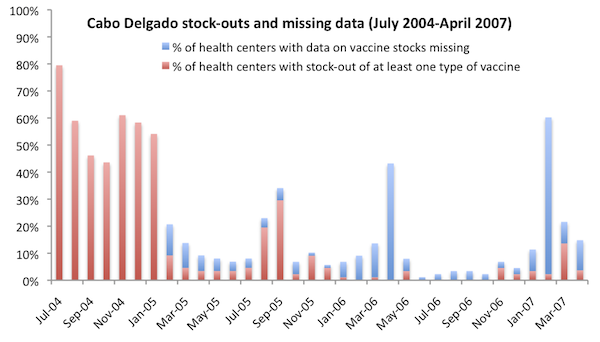
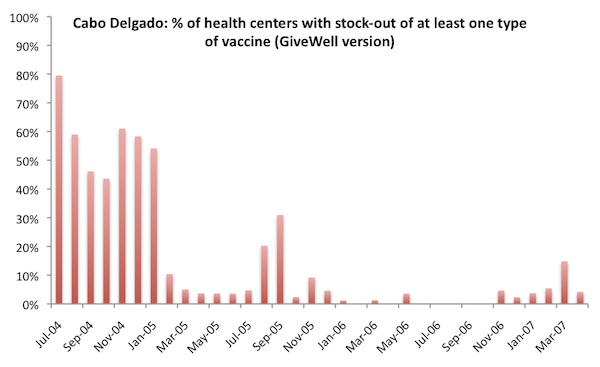
  • New information is available. This data includes: (A) health surveys released in 2010 that measure immunization rates in Mozambique. These surveys offer another source for data relevant to VillageReach’s project that was not available when we first assessed the pilot project. (B) In preparation for its scale-up, VillageReach returned to Cabo Delgado (the province in which it ran its pilot project) and conducted its own survey of immunization rates there. The newest survey raises questions about the impact of the pilot program and we will be conducting and publishing further analysis in the coming months. So far, we’ve conducted a re-analysis of VillageReach’s stockout and vaccination rate data.

As the first charity we directed significant funding to, VillageReach represents one of our best available learning opportunities. This is particularly true due to VillageReach’s continuing transparency and commitment to collecting meaningful data – qualities we believe are rare and outstanding. We intend to continue to take full advantage of this learning opportunity, even if it means publishing more discouraging news.

Guest post from John Beale at VillageReach

This is a guest post from John Beale, VillageReach’s Director, Strategic Development & Group Lead, Social Business Group.

VillageReach has been reviewed by GiveWell since mid-2009, and was recommended as its #1 recommendation for two years, until November 2011. In providing this updated review of our work in Mozambique, we see a need to explain the context for what we do.

Two key principles define the organization:

  1. our mission is to save lives and improve health by increasing access to quality healthcare for remote, underserved communities; and
  2. an emphasis on measurement, results and transparency in reporting its plans, challenges, failures and results.

The organization was established in 2000, and for years directed all of its efforts at a demonstration project in Mozambique. During the past three years, the scope and scale of VillageReach has increased dramatically: we are engaged in numerous new projects supported by our donors, foundations, USAID and other international development organizations. All of this additional work to improve health systems was borne out of the initial experience we gained in working on the initial Mozambique demonstration project.

Our interest in transparency is common to many of our donors and core to GiveWell’s mission. In our case, we see the need for new approaches to improving health systems in low-income countries that can yield greater impact at lower cost. Our focus is to strengthen existing health systems through improvements in health system capacity (supply chain, management and personnel training), information technology (to improve the quality of data reported from the field) and the creation of social businesses (that create shared infrastructure to improve transportation, energy supply and communications for rural health facilities and surrounding communities).

We focus on the last mile of the health system, where a lack of human resource capacity and infrastructure can limit the ability of the system to serve its communities. Instead of looking top-down, we see greater improvements being made possible by looking bottom-up. To highlight the benefits of this approach, it is clear to us that we must be objective in publicly documenting both the challenges and successes the approach records, and to draw attention to the need to allocate more global health resources to improving access to healthcare.

There are naturally risks in trying new approaches in search of significant rewards. We accept that there are risks and that we will not succeed all the time; but, we believe that through taking chances, sometimes making mistakes, learning and adjusting, we will achieve results for communities whose basic need for healthcare have been left unmet for too long. We believe many of our supporters share our vision.

For the Mozambique expansion, we tested the sustainability of the system with a new approach under which local governmental health authorities assume responsibility to operate and fund the distribution system. What we found, is that when government funding is erratic, the vaccines are not distributed. As a result, the availability and quality of healthcare becomes erratic, and ultimately the communities we seek to serve suffer. We evaluated the program, saw that there were too many months when vaccines were not getting distributed adequately, and quickly decided to intervene to achieve our primary goal. Because improving health outcomes is a higher priority for us than sustainability, we have agreed – at the cost of about $25,000 per province per year – to step in to fill gaps in government funding when necessary to ensure the distributions occur on a regular basis as we develop new approaches that can smooth the government’s funding streams. This sort of adaptation is important to achieving results, and since this change we’ve seen the vaccine distributions happening every month.

It’s also in our best interests to expose the challenges in what we are attempting to do as much as the successes. We’re looking for system change in global health: our effort is to lead by example and document the results. This system change perspective hasn’t been covered by GiveWell because the focus is more purely on transparency and measureable success.

VillageReach’s view is there is a lot of innovation in global health but insufficient effort to ensure the innovations reach the underserved. We’re engaged in improving health systems in order to save lives, but the broader goal is to see governments and other organizations doing this type of work because the need extends well beyond VillageReach’s modest resources. Some contributors clearly prefer to support only organizations they deem to be successful, but many of our supporters are interested in our approach because we’re trying to achieve something that’s difficult and unpredictable, but still worthy and representing a needed change.

We will continue to work to reach the underserved, documenting what worked, as well as what didn’t.

John Beale
Director, Strategic Development &
Group Lead, Social Business Group